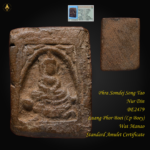
Phra Somdej Song Singha Nur Din BE2479 Luang Phor Boei (Lp Boey) Wat Manao
| Type | Phra Somdej Song Singha |
| Monk | Luang Phor Boey (Lp Boi) |
| Temple | Wat Manao |
| B.E. Year | 2479 |
| Material | Nur Din |
| Condition | Very Good |
| Certificate | Standard Amulet |
| SKU | TAC-PhraSomdejSongSingha-LpBoei(LpBoey)-001 |
Authentic Phra Somdej Song Singha by Luang Phor Boey (Lp Boi), Wat Manao BE 2479, pressed in Nur Din. Standard Amulet certified. Available from TAC, Singapore.
What is the Phra Somdej Song Singha by Luang Phor Boey (Lp Boi)?
The Phra Somdej Song Singha Luang Phor Boey (Lp Boi) is an early Rattanakosin-era amulet created at Wat Manao in Bang Pla Ma District, Suphanburi Province. Pressed in nuea (material/substance) Din — sacred consecrated clay — and dated BE 2479, it carries a Standard Amulet certificate. Supply is permanently fixed: Luang Phor Boey (Lp Boi) passed away on 18 January 1965 (BE 2508).
The monk behind the piece
Luang Phor Boey (Lp Boi) was born in 1892 (BE 2435, Year of the Dragon) in Ban Sam Muang, Bang Pla Ma Subdistrict, Suphanburi Province. His father was a rice farmer in a community known for both agriculture and blacksmithing. That grounded, ordinary background shaped the way he carried himself as a monk throughout his life.
He was ordained at Wat Manao at age 21 (BE 2456), then spent three rains retreats there before travelling to study Dhamma and Vinaya at Wat Srisuttharam in Thonburi around BE 2459 — roughly eight to nine years in residence. He then sought advanced Vipassana training under two established masters of that era: Luang Phor Niam of Wat Noi and Luang Phor Phan of Wat Bang Nom Kho in Ayutthaya. In BE 2467 he returned to Wat Manao and stayed permanently, living simply and in seclusion.
What separates him from many monks of his generation is the documented restraint he exercised around his own amulets. He declined high ecclesiastical positions, refused large donations, and distributed every sacred object he created freely — nothing was sold. That track record matters to serious collectors. It speaks to the integrity of everything that came out of Wat Manao under his watch.
Wat Manao and the BE 2479 Nur Din pressing
Wat Manao is a Rattanakosin-period temple with a single defining characteristic: its reputation rests almost entirely on one monk. Luang Phor Boey was ordained here, trained here, and spent his final decades here. The temple’s standing in the broader Thai Buddhist amulet tradition is inseparable from his presence. In BE 2508, an ubosot boundary consecration ceremony was held at the temple — an occasion on which Luang Phor Boey distributed two coin types freely to the congregation, confirming that the practice of free distribution ran throughout his career.
The BE 2479 piece is pressed in Nur Din — sacred clay — as its primary nuea. Nur Din compositions in Thai amulet craft typically combine consecrated earth from spiritually significant sites with binding agents and phong (sacred powder blend). Around BE 2473, lay devotees contributed brass, bronze, silver, gold, stone mortar, and traditional utensils for amulet creation at the temple, illustrating the communal intent behind the materials used. Luang Phor Boey’s BE 2500 batch, by contrast, incorporated betel nut chew saved for fifteen to twenty years, incense powder, dried flowers, earth, and palm sugar as a binder — showing how deliberately he selected ingredients across different runs.
The Singha (lion) iconography in the pim (mould collectors authenticate against) represents strength and the capacity to overcome adversity. It is a direct visual statement about the kind of protection collectors have historically associated with this piece.
What to check and how it is certified
This piece carries a Standard Amulet certificate — formal inspection and documentation providing a baseline of verified authenticity. For a BE 2479 specimen acquired remotely by collectors in Singapore, Malaysia, Hong Kong, or Taiwan, that paperwork is the starting point, not the end of due diligence.
Authentication points collectors examine on genuine examples:
- Surface aging consistent with Nur Din clay of the late BE 2470s — look for natural crazing and dry mineral texture, not artificial surface treatment
- Pim characteristics specific to Wat Manao’s production style — the Singha positioning and Somdej base proportions are the reference points
- Period-consistent material density and weight typical of hand-pressed clay amulets from Suphanburi Province in this era
Luang Phor Boey passed away on 18 January 1965 (BE 2508). No new pieces can enter the market from him. Every authenticated BE 2479 specimen is a finite item. Collectors in the niyom (collector-standard reference) community across Thailand and Greater China treat his early Wat Manao pressings accordingly.
This piece represents a rare opportunity to acquire a Nur Din (earthen paste) Phra Somdej Song Singha dated to BE 2479, crafted by Luang Phor Boey of Wat Manao — a monk whose lineage traces directly through two of the most revered Vipassana masters of the early Rattanakosin era, Luang Phor Niam and Luang Phor Phan of Wat Bang Nom Kho. The Song Singha iconographic form, with its twin lion flanking motif, is a relatively uncommon variant within the broader Somdej typology, making examples from this period and temple particularly sought after by serious period collectors. We at TAC are pleased to offer this piece with a standard amulet certificate, and prospective collectors are encouraged to review the certification details and conduct their own comparison study against documented reference examples from Wat Manao's BE 2479 batch.
Attributes reflect Thai Buddhist devotional tradition and are not measurable claims.