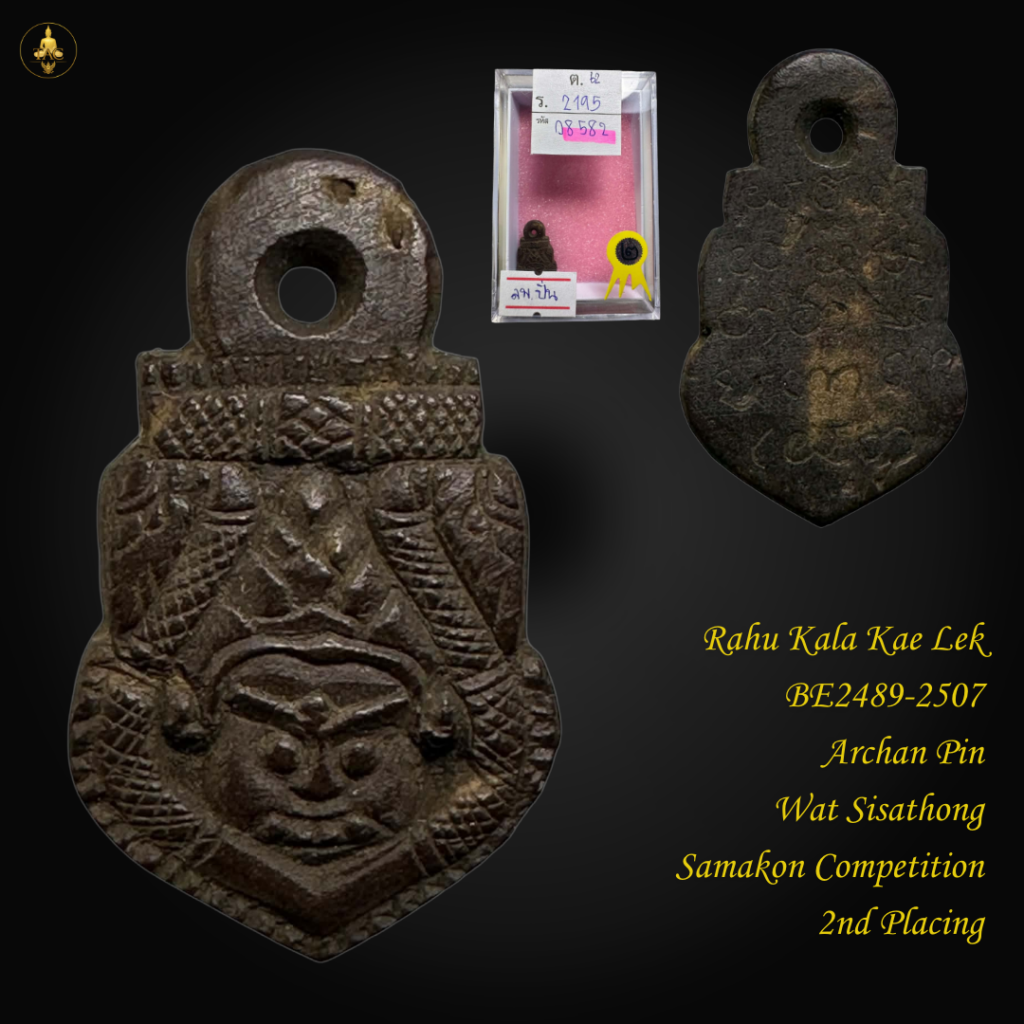
Rahu Kala Kae Lek BE2489-2507 Luang Phor Pin (Archan Pin) Wat Sisathong
| Type | Rahu Kala Kae Lek |
| Monk | Luang Phor Pin (Archan Pin) |
| Temple | Wat Sisathong |
| B.E. Year | 2489 |
| Material | Nur Kala Kae |
| Pim / Mold | Lek |
| Condition | Good |
| Certificate | Competition #Samakon |
| SKU | TAC-RahuKalaKaeLek-LpPin(ArchanPin)-001 |
Authentic Rahu Kala Kae Lek Luang Phor Pin (Archan Pin), Wat Sisathong BE 2489-2507. Nur Kala Kae, Samakon certified. Trusted Thai amulet Singapore dealer.
What is the Rahu Kala Kae Lek amulet by Luang Phor Pin (Archan Pin)?
The Rahu Kala Kae Lek Luang Phor Pin (Archan Pin) is an authentic Thai amulet produced at Wat Sisathong, Nakhon Pathom Province, during BE 2489–2507. Crafted from Nur Kala Kae — a rare one-eyed coconut shell — this amulet is traditionally venerated for its protective and fortune-enhancing properties, and has been certified through the Samakon Competition.
The Rahu Kala Kae Lek is small and compact, crafted in the traditional Sema-shaped design commonly used for Thai sacred amulets. The front features a finely carved image of Rahu, while the reverse is engraved with sacred inscriptions. This distinctive form has become one of the most recognisable amulet types associated with the Wat Sisathong lineage.
Luang Phor Pin (Archan Pin), the former abbot of Wat Sisathong, was the principal disciple of Luang Phor Noi of Wat Sisathong. He inherited the complete lineage and knowledge of creating Rahu amulets carved from coconut shells. This direct transmission of sacred knowledge is central to the spiritual authority that collectors and devotees attribute to every Rahu Kala Kae Lek Luang Phor Pin (Archan Pin).
During Luang Phor Noi’s later years, many of the Rahu coconut shell amulets were carved and inscribed by Luang Phor Pin before being presented to Luang Phor Noi for the final consecration ceremony. This collaborative practice continued into the early years of Luang Phor Pin’s own amulet-making tradition. After the passing of Luang Phor Noi, Luang Phor Pin succeeded him as abbot and faithfully continued the temple’s long-standing tradition of creating and consecrating Rahu amulets carved from coconut shells, preserving this sacred lineage for future generations.
Rahu Kala Kae Lek and Wat Sisathong Heritage
Wat Sisathong, located in Nakhon Pathom Province, is one of the most historically significant temples in Thailand for the creation of Rahu amulets carved from coconut shell. The temple’s unbroken lineage — from Luang Phor Noi through to Luang Phor Pin (Archan Pin) — is regarded by the collector community as a hallmark of authenticity and spiritual continuity. This heritage gives the Rahu Kala Kae Lek Wat Sisathong series its exceptional standing among serious amulet collectors across Southeast Asia.
The tradition of Rahu amulet creation at Wat Sisathong spans the BE 2489–2507 period, encompassing decades of consecration ceremonies and sacred craftsmanship. Collectors in Singapore, Malaysia, Taiwan, and Greater China actively seek pieces from this era precisely because of the documented lineage and the rigorous consecration standards maintained at the temple. To understand more about the broader context of these sacred objects, the Thai Buddhist amulet tradition has deep roots in Theravada Buddhist practice and animist belief that span centuries.
The temple’s significance is further underscored by the fact that amulets from Wat Sisathong have been formally recognised through the Samakon Competition — one of the most respected certification processes in the Thai amulet community. This institutional recognition elevates the Rahu Kala Kae Lek BE 2489–2507 series above many contemporary pieces in terms of provenance and collector confidence.
Nur Kala Kae — Rahu Kala Kae Lek Composition and Craftsmanship
The term Nur Kala Kae refers specifically to the rare one-eyed coconut shell used as the primary material for this amulet. In Thai spiritual belief, one-eyed coconut shells are associated with invincibility, protection, charm, good fortune, and the ability to strengthen one’s destiny. This material is considered inherently mystical, and its scarcity makes each finished Nur Kala Kae Rahu Kala Kae Lek a uniquely precious object.
Each amulet is hand-carved with a finely detailed image of Rahu on the front face. The reverse is engraved with sacred Khom script inscriptions, which encode the protective and spiritual intentions of the monk during the creation process. This combination of rare natural material and sacred inscription reflects the high level of craftsmanship that defines the Wat Sisathong tradition.
The production of these amulets was never undertaken as a mass manufacture. The carving, inscription, and consecration stages were each treated as sacred acts requiring the monk’s full spiritual focus. This careful, ceremony-centred process is one of the key reasons why the Luang Phor Pin (Archan Pin) amulet series from this period commands lasting respect among collectors and devotees alike.
Spiritual Benefits of Rahu Kala Kae Lek by Luang Phor Pin (Archan Pin)
Devotees and collectors associate the Rahu Kala Kae Lek Luang Phor Pin (Archan Pin) with a wide range of protective and fortune-enhancing qualities. It is traditionally venerated for its ability to safeguard the wearer during periods of misfortune and to improve one’s destiny over time. Collectors in Singapore and across Greater China regard this amulet as one of the most potent Rahu pieces from the mid-20th century Thai amulet tradition.
Devotees believe that the greatest benefits are achieved only when the wearer lives according to moral principles and performs good deeds — a teaching consistently emphasised within the Wat Sisathong tradition. This ethical dimension is regarded as inseparable from the amulet’s spiritual efficacy.
- Protection from danger: Traditionally venerated for shielding the wearer from various dangers, negative energies, and black magic during difficult periods.
- Wealth, popularity, and prestige: Collectors associate this amulet with attracting good fortune, social standing, and material prosperity.
- Health and destiny improvement: Regarded by devotees as supportive of good health and capable of helping to alleviate illness, while strengthening one’s overall life trajectory.
Rahu Kala Kae Lek BE 2489-2507 — Authentication and Collector Value
The Rahu Kala Kae Lek BE 2489–2507 series is among the most sought-after Thai amulet collections from the post-war era. Pieces from this period have been formally certified through the Samakon Competition, which is widely recognised as one of the most authoritative amulet authentication processes in Thailand. Samakon certification provides collectors with a documented basis for provenance, significantly reducing the risk of acquiring a reproduction.
The rarity of the Nur Kala Kae material — genuine one-eyed coconut shell — means that authenticating the raw material itself is a key step in verification. Collectors and dealers specialising in authentic Thai amulets in Singapore and Malaysia typically cross-reference the material, carving style, inscription patterns, and Samakon certification records when evaluating a piece. The long production span of BE 2489–2507 means there is meaningful variation across batches, and condition grading plays an important role in determining collector value.
Demand for the Luang Phor Pin (Archan Pin) amulet from Wat Sisathong has remained consistently strong across Southeast Asia and Greater China. As supply of genuine pieces from this era continues to contract, certified examples are regarded by the collector community as both spiritually significant and increasingly valuable from an investment perspective. For collectors seeking a Thai amulet Singapore source, provenance documentation and Samakon certification are the two most critical factors to verify before acquisition.
Attributes reflect Thai Buddhist devotional tradition and are not measurable claims.