Phra Suphan – A Legendary Amulet of Thailand
Discover the Phra Suphan History and Story - A Legendary Amulet of Thailand — its Benjapakee origins, gold inscription records, and collector value across Singapore and Southeast Asia.
Origins and Historical Context of Phra Suphan
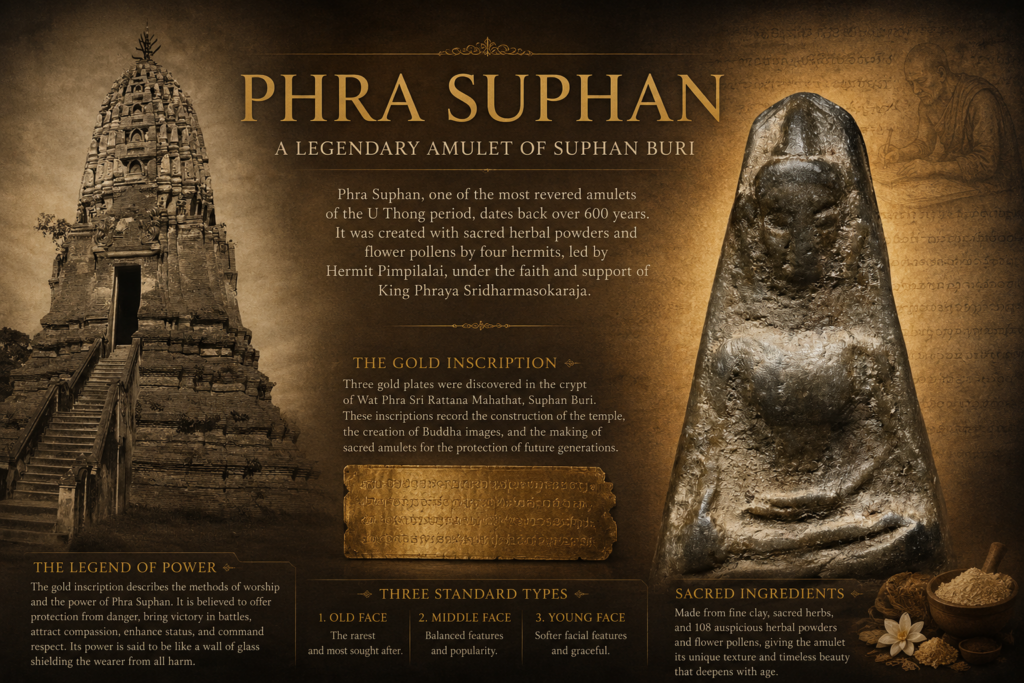
The history of Phra Suphan begins more than six centuries ago during the flourishing U Thong Kingdom, making this amulet one of the oldest and most historically significant objects in Thai amulet history. Its creation belongs to the Ayutthaya period, placing it within one of the most artistically and religiously productive eras in Thai Buddhist tradition.
Most scholars associate the amulet’s creation with the reign of either King Borommarachathirat II — also known as Chao Sam Phraya — or King Borommatrailokkanat of the Ayutthaya Kingdom. Although the identity of the original craftsman remains unknown, the historical record is unusually well-supported by physical archaeological evidence.
The most significant archaeological discovery associated with this amulet was made at Wat Phra Sri Rattana Mahathat in Suphan Buri Province. Inside a crypt beneath the temple, three gold inscription plates were uncovered, describing the construction of the temple, the creation of sacred Buddha images, and the making of powerful amulets intended to preserve Buddhism and protect future generations.
These gold inscriptions represent one of the most important historical references in all of Thai amulet history. They provide rare, first-hand documentary evidence for the sacred origin of this amulet — a level of historical verifiability that very few ancient Thai amulets can claim. For collectors seeking an authentic Thai amulet with verifiable provenance, this documentary record significantly enhances Phra Suphan’s standing.
Key Events and Sacred Significance of Phra Suphan
The consecration of Phra Suphan is distinguished by one of the most elaborately documented ceremonies in Thai amulet history, recorded on a gold inscription plate translated by His Royal Highness Prince Vajirayanavarorasa. This royal translation elevated the inscription’s credibility and made it a cornerstone reference within the wider field of Thai amulet history.
According to the inscription, four hermits led by Hermit Pimpilalai performed an elaborate sacred ceremony using specially crafted ritual instruments and precious materials. King Phraya Sridharmasokaraja conducted the ceremony with full participation — out of deep faith and respect for the hermits, the king personally gathered numerous sacred herbs and presented them for use in the consecration.
This account is remarkable within the broader landscape of Thai Buddhist tradition. It is rare for a royal figure to appear in the historical record gathering sacred materials personally, and the direct involvement of four learned ascetics under Hermit Pimpilalai lends the ceremony an exceptional level of spiritual authority. The inscription does not merely name the amulet — it records the specific actors, their roles, and the materials used, creating an unusually complete historical record.
This sacred ceremony and its royal patronage are central to why Phra Suphan continues to command such reverence among collectors and devotees across generations.
Why the Name “Phra Suphan” — and What Makes This Authentic Thai Amulet Unique
The name “Phra Suphan” derives directly from the sacred powder and herbal composition used in the amulet’s creation, as recorded in the gold inscriptions. According to those inscriptions, the amulet was originally known as Phra Kesor Suphan, meaning “Suphan Pollen Amulet,” a name that reflects the extraordinary care taken in selecting its raw materials.
The amulet was made from a carefully prepared mixture of fine clay, sacred herbal powders, flower pollens, and concentrated extracts of auspicious medicinal plants. Ancient craftsmen are recorded to have selected 108 sacred herbs and auspicious flower pollens, blending them with fine clay to create an exceptionally refined material — a composition that remains one of the most detailed material records associated with any Benjapakee amulet.
This unique material composition gives genuine Phra Suphan amulets a distinctive texture that changes over time. Over many decades of worship and natural environmental exposure, the surface gradually becomes smoother and develops a rich natural lustre. Experienced collectors and dealers refer to this characteristic as the amulet “maturing through herbs,” reflecting the understanding that the herbal ingredients continue to influence the amulet’s physical appearance over decades.
How to Identify and Authenticate Phra Suphan
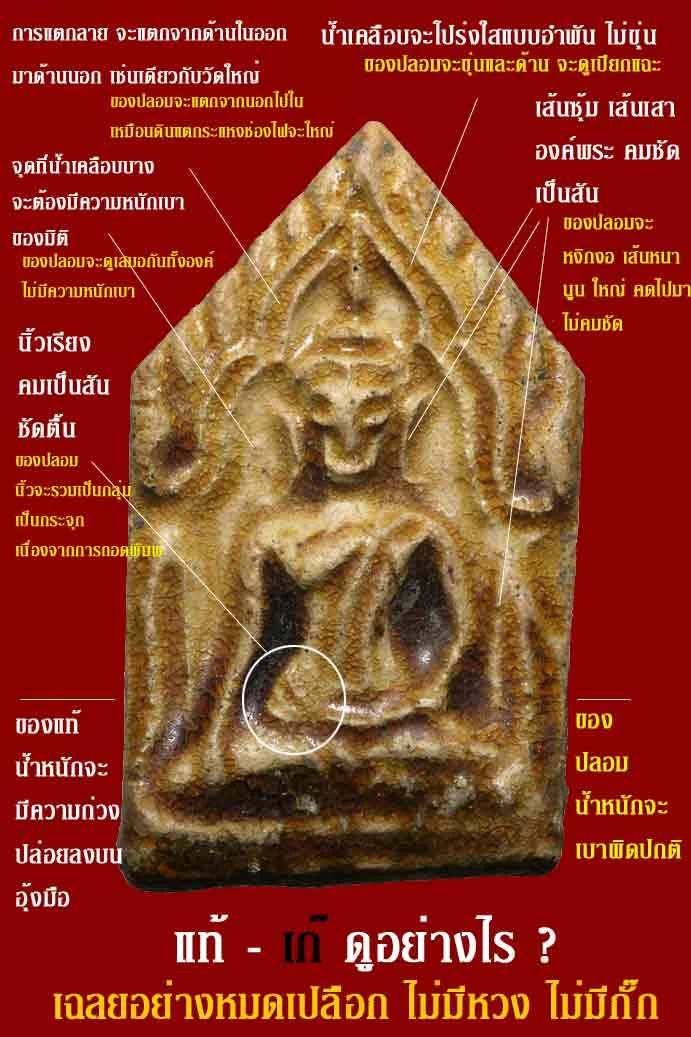
Authenticating Phra Suphan requires close attention to both physical characteristics and provenance documentation, as the market contains many imitations. In our experience as a dealer serving collectors across Singapore, Malaysia, and Greater China, the most common authentication challenges involve surface texture assessment and mould-line verification on Old Face types.
The material composition of a genuine piece — derived from 108 sacred herbs, flower pollens, and fine clay — produces surface qualities that are difficult to replicate convincingly. An aged authentic piece will show the characteristic herbal maturation lustre, a smooth yet slightly granular surface feel, and natural age-consistent colouring rather than artificial patina.
- Surface texture: Genuine pieces show a naturally smoothed surface with a subtle herbal lustre that develops through age, not artificial polishing.
- Mould precision: The Old Face type displays fine, crisp relief lines consistent with early Ayutthaya period craftsmanship — not blurred or over-pressed impressions.
- Material composition: Authentic pieces have a distinctive clay-herb mixture that produces a consistent density and slightly warm colouration under natural light.
- Provenance documentation: High-value pieces should be accompanied by certification from recognised Thai amulet evaluation committees or documented collector lineage.
- Age-consistent wear: Natural wear appears at contact points — edges, raised relief — not uniformly across the surface, which indicates artificial ageing.
Phra Suphan’s Impact on Thai Amulet Tradition and Collector Value
Phra Suphan has shaped the standards of the entire Thai amulet collecting world, serving as a benchmark for provenance verification, material quality, and sacred ceremony documentation. Its inclusion in the Benjapakee set — Thailand’s five most prestigious ancient amulets — places it in the highest tier of the collector market across Thailand, Singapore, and Greater China.
The detailed gold inscription record, the royal involvement of King Phraya Sridharmasokaraja, and the scholarly translation by Prince Vajirayanavarorasa give this amulet a level of historical legitimacy that is extremely rare within the field of Thai Buddhist amulet tradition. This documented history directly supports higher collector valuations, particularly for the Old Face variety, where exceptional preservation combined with documented provenance commands premium prices at major Thai amulet fairs and auction events.
The amulet’s six-century history also means that the finest surviving examples have passed through multiple generations of collector ownership, each adding to the documented lineage. For collectors in Singapore and across Southeast Asia, acquiring a piece with clear lineage documentation is considered the most important factor after physical authentication.
Collector Guide: Phra Suphan for Singapore and Southeast Asia
For collectors in Singapore, Malaysia, Taiwan, and Hong Kong, Phra Suphan represents one of the most historically grounded investment-grade amulets available in the market today. Demand for the Old Face type in particular has remained consistent across decades, driven by its rarity, its Benjapakee status, and the unusually strong historical documentation supporting its origin.
New collectors entering the market should prioritise pieces that come with recognised certification or established collector lineage, and should study the distinctive material characteristics — particularly the herbal maturation surface quality — before making significant acquisitions. Working with established dealers who have deep familiarity with Ayutthaya-period amulet material is the most reliable approach to building a credible Phra Suphan collection. As a Thai amulet Singapore specialist, thaiamuletscollection.com provides authentication guidance and sourcing support for collectors across the region.
Frequently asked questions
Phra Suphan, also known as Phra Phong Suphan, is an ancient Thai Buddhist amulet originating from the U Thong Kingdom more than six centuries ago. It is one of the five amulets comprising the Benjapakee set — Thailand's most prestigious grouping of ancient amulets — recognised for its verifiable historical provenance, elaborate documented consecration ceremony, and exceptional material composition of 108 sacred herbs and flower pollens.
Three gold inscription plates were discovered inside a crypt at Wat Phra Sri Rattana Mahathat in Suphan Buri Province. These plates document the construction of the temple, the creation of sacred Buddha images, and the making of the amulets. One inscription recording the consecration ceremony was translated by His Royal Highness Prince Vajirayanavarorasa, providing an unusually complete and credible historical record by the standards of Thai amulet scholarship.
The Old Face type is considered the rarest and most desirable variety among all known Phra Suphan amulets. Its value derives from the fine, crisp relief lines consistent with early Ayutthaya period craftsmanship, combined with its age-consistent surface maturation and the limited number of well-preserved examples that have survived six centuries with documented collector lineage.