Luang Pu Louis Chanthasaro
Luang Pu Louis Chanthasaro (หลวงปู่หลุยส์ จันทสาโร) was a highly venerated Thai Buddhist monk born in BE 2444 (AD 1901) who dedicated his monastic life to the forest meditation tradition at Wat Tham Phabing (วัดถ้ำผาบิ้ง), located in Loei Province (จังหวัดเลย), northeastern Thailand. He is widely regarded as one of the most spiritually accomplished disciples of the legendary Luang Pu Mun Bhuridatto (หลวงปู่มั่น ภูริทัตโต), placing him firmly within the revered Kammatthana forest tradition that has produced some of the most sought-after Buddhist amulets in modern Thai amulet collecting history. Among devotees and collectors across Southeast Asia and the Chinese-speaking world, Luang Pu Louis Chanthasaro is most celebrated for his exceptionally rigorous ascetic practice, his deep meditative attainments, and the sacred amulets consecrated under his spiritual authority at Wat Tham Phabing, which are prized for their reputed protective and merit-generating qualities. Read more ↓
Biography
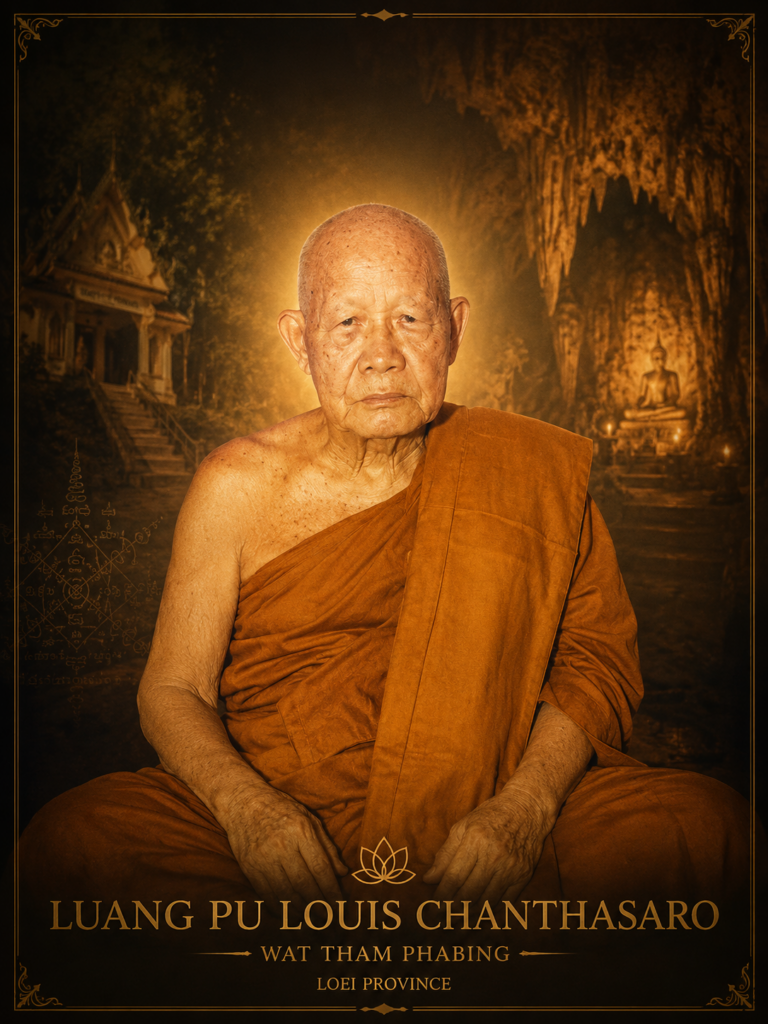
Luang Pu Louis Chanthasaro (หลวงปู่หลุยส์ จันทสาโร) was a highly venerated Thai Buddhist monk born in BE 2444 (AD 1901) who dedicated his monastic life to the forest meditation tradition at Wat Tham Phabing (วัดถ้ำผาบิ้ง), located in Loei Province (จังหวัดเลย), northeastern Thailand. He is widely regarded as one of the most spiritually accomplished disciples of the legendary Luang Pu Mun Bhuridatto (หลวงปู่มั่น ภูริทัตโต), placing him firmly within the revered Kammatthana forest tradition.
Among devotees and collectors across Southeast Asia and the Chinese-speaking world, Luang Pu Louis Chanthasaro is most celebrated for:
- His exceptionally rigorous ascetic practice
- His deep meditative attainments within the Kammatthana lineage
- The sacred amulets consecrated under his spiritual authority at Wat Tham Phabing, prized for their reputed protective and merit-generating qualities
The Kammatthana forest tradition has produced some of the most sought-after Buddhist amulets in modern Thai amulet collecting history, and Luang Pu Louis Chanthasaro stands as one of its most respected figures.
Early Life and Ordination
Origins in Loei Province
Luang Pu Louis Chanthasaro (หลวงปู่หลุยส์ จันทสาโร) was born in BE 2444 (AD 1901) in the Loei Province region of northeastern Thailand, an area historically known for its deep-rooted Theravada Buddhist culture and its close proximity to the forested mountain landscapes that became synonymous with the Thai forest monk tradition. Detailed records of his family background and early childhood are not widely documented in English sources, though regional Thai-language accounts consistently describe him as coming from a devout Buddhist household that nurtured his early interest in the Dhamma.
Ordination and Monastic Name
He entered the monastic order through the traditional Upasampada ordination ceremony, taking the Pali ecclesiastical name Chanthasaro (จันทสาโร), meaning “one who has the essence of the moon” — a name that would come to reflect the calm, luminous quality of his character as described by those who encountered him. His ordination placed him on a path that would eventually lead him to the heart of the Kammatthana (กัมมัฏฐาน) forest meditation tradition, one of the most respected lineages within Thai Theravada Buddhism. The precise BE year of his ordination is not widely documented in English sources.
Spiritual Development and Practice
The Kammatthana Lineage
Luang Pu Louis Chanthasaro’s spiritual development unfolded within the rigorous framework of the Thai forest tradition, most directly shaped by his association with Luang Pu Mun Bhuridatto (หลวงปู่มั่น ภูริทัตโต), the towering patriarch of the Kammatthana lineage whose influence extended across the entire northeastern Thai monastic landscape. This lineage is rooted in:
- Strict Vinaya discipline
- Intensive Vipassana (วิปัสสนา) insight meditation
- Extended periods of solitary practice in remote forests and mountain caves
These foundations produced monks of extraordinary spiritual depth, and Luang Pu Louis is regarded as a representative example of the lineage at its most austere.
Practice at Wat Tham Phabing and Tudong Wandering
Luang Pu Louis is particularly associated with his long residence at Wat Tham Phabing, a cave temple whose natural rock formations and mountainous surroundings in Loei Province provided an ideal environment for advanced meditative retreat. He is said to have practised Tudong (ธุดงค์), the ancient wandering ascetic practice of forest monks, traversing the highlands of the north and northeast in search of suitable places for deep meditation.
Devotees and scholars of the Thai forest tradition speak of his attainments in Samatha (สมถะ) concentration practice as a foundation for profound Vipassana insight. Accounts within the Thai-language oral tradition describe him as a monk of great inner stillness and moral authority. His specific teachers beyond the Luang Pu Mun lineage are not widely documented in English sources.
Amulet Consecrations and Collector Significance
The Forest Tradition Approach to Amulet Production
For collectors and devotees, the amulets associated with Luang Pu Louis Chanthasaro (หลวงปู่หลุยส์ จันทสาโร) represent a tangible connection to one of the most respected branches of the Thai forest meditation tradition. Because Wat Tham Phabing (วัดถ้ำผาบิ้ง) is a relatively remote temple in Loei Province, the historical record of its amulet consecrations is less comprehensively catalogued in mainstream collector databases than those of larger Bangkok or Chiang Mai institutions. This relative scarcity is itself a factor that heightens collector interest in genuine pieces.
The amulet culture surrounding forest tradition monks such as Luang Pu Louis differs in important respects from that of urban temple monks. Rather than large-scale commercial consecration ceremonies involving thousands of amulet batches, forest tradition amulets were typically produced in smaller, more spiritually focused runs — often initiated at the request of lay devotees and consecrated through extended periods of monk meditation and chanting rather than single-day ceremonies. This practice gives each surviving piece a character that collectors describe as carrying an authentic spiritual weight.
Known Amulet Types
Within the Thai collector community, amulets connected to Luang Pu Louis Chanthasaro and Wat Tham Phabing are generally understood to include the following categories:
- Pressed powder tablets (phra phim / พระพิมพ์): made from sacred herb-and-ash compounds
- Metal coins (rian / เหรียญ): bearing the monk’s image
- Cast figurines (roop muean / รูปเหมือน): modelled on the monk’s likeness
These material categories align with standard forest tradition amulet production practices across the Kammatthana lineage temples of the northeast.
Material Traditions
In keeping with the forest tradition’s emphasis on austerity and the sacred use of natural materials, amulets from this lineage frequently incorporate pong (ผง) — sacred powder derived from monk-blessed herbs, charred incense, and temple soil — combined with binding agents. Metal amulets from such temples often use alpaca silver (tong pae / ทองแดง) or brass, sometimes with gold-plated finishes for special consecration editions.
Batch Documentation and Research Guidance
The specific batch names, BE years, and material compositions of amulets formally attributed to Luang Pu Louis Chanthasaro are not widely documented in English sources. Collectors and researchers seeking authoritative batch records are advised to consult:
- Thai-language temple publications from Wat Tham Phabing
- Specialist Thai amulet certification bodies such as G-Pra and Samakom
- Experienced dealers with direct provenance connections to Loei Province
The rarity of formally documented Luang Pu Louis Chanthasaro amulets in the international market makes authenticated pieces of particular interest to serious collectors in Singapore, Malaysia, Taiwan, and Hong Kong who specialise in forest tradition monks. Provenance-verified examples from Wat Tham Phabing carry significant spiritual and collectible value precisely because they are not mass-produced items.
Thai Amulets Collection (TAC) notes that the monk record for Luang Pu Louis Chanthasaro is not yet fully entered into its database. Collectors with specific batch enquiries are encouraged to contact TAC directly for expert guidance and sourcing assistance.
Legacy and Temple Significance
Establishing Loei Province Within the Forest Tradition
Luang Pu Louis Chanthasaro (หลวงปู่หลุยส์ จันทสาโร) left a legacy that extends well beyond his personal spiritual accomplishments. As a direct heir of the Luang Pu Mun Bhuridatto lineage and a long-term resident master of Wat Tham Phabing (วัดถ้ำผาบิ้ง), he helped to establish Loei Province as a recognised centre of the Thai forest meditation tradition alongside the better-known forest temple networks of Udon Thani and Nakhon Ratchasima.
Wat Tham Phabing as a Living Pilgrimage Site
Wat Tham Phabing itself — a cave temple set within the dramatic limestone and forested mountain landscape of Loei — is venerated today both as a place of active monastic practice and as a pilgrimage site for devotees who come to pay respects at shrines dedicated to the monks who shaped the temple’s spiritual identity. Within Thai Buddhist culture, the memory of highly attained forest monks is preserved through the creation and veneration of their amulets and sacred images, which serve as focal points for merit-making, protection, and the perpetuation of the Dhamma.
The annual ceremonies and memorial observances held at Wat Tham Phabing in honour of Luang Pu Louis Chanthasaro are not widely documented in English sources, though the temple remains an active site of Theravada practice. For collectors across the TAC community in Singapore, Malaysia, China, Taiwan, and Hong Kong, his name represents an authentic link to one of Thai Buddhism’s most spiritually serious monastic traditions.
Frequently Asked Questions
Who was Luang Pu Louis Chanthasaro?
Luang Pu Louis Chanthasaro (หลวงปู่หลุยส์ จันทสาโร) was a highly venerated Thai Buddhist monk born in BE 2444 (AD 1901). He was a direct disciple of Luang Pu Mun Bhuridatto and spent his monastic life at Wat Tham Phabing in Loei Province, northeastern Thailand, where he practised within the Kammatthana forest meditation tradition.
What does the name Chanthasaro mean?
Chanthasaro (จันทสาโร) is a Pali ecclesiastical name meaning “one who has the essence of the moon.” It was given to him at his Upasampada ordination ceremony and is regarded as reflecting the calm, luminous quality of character described by those who encountered him.
Which lineage did Luang Pu Louis Chanthasaro belong to?
He belonged to the Kammatthana (กัมมัฏฐาน) forest meditation lineage, as a direct disciple of Luang Pu Mun Bhuridatto (หลวงปู่มั่น ภูริทัตโต), the patriarch of that tradition. This lineage is distinguished by strict Vinaya discipline, intensive Vipassana meditation, and solitary practice in remote forests and mountain caves.
What types of amulets are associated with Luang Pu Louis Chanthasaro?
Amulets connected to Luang Pu Louis Chanthasaro and Wat Tham Phabing generally include pressed powder tablets (phra phim), metal coins (rian) bearing his image, and cast figurines (roop muean) modelled on his likeness. These align with standard forest tradition amulet production practices across Kammatthana lineage temples in northeastern Thailand.
Why are Luang Pu Louis Chanthasaro amulets considered rare?
Wat Tham Phabing is a relatively remote temple in Loei Province, and forest tradition amulets were produced in smaller, more spiritually focused runs rather than large-scale commercial batches. This limited production, combined with incomplete cataloguing in mainstream collector databases, means that authenticated pieces are uncommon in the international market.
Where can collectors find authoritative information on specific amulet batches?
Collectors seeking verified batch records are advised to consult Thai-language temple publications from Wat Tham Phabing, specialist Thai amulet certification bodies such as G-Pra and Samakom, and experienced dealers with direct provenance connections to Loei Province. Thai Amulets Collection (TAC) may also be contacted directly for expert guidance and sourcing assistance.