Luang Pu Suan (Yat Than Suan Chantharo) Wat Na Udom
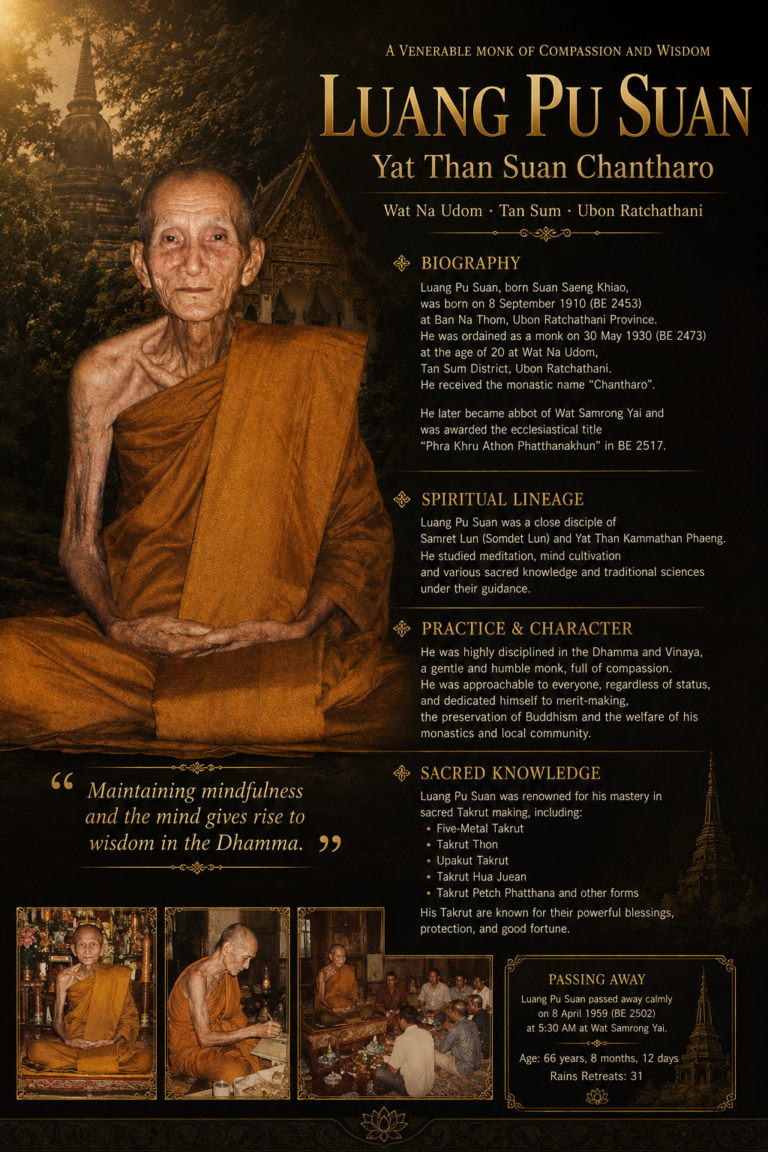
Luang Pu Suan (หลวงปู่สวน), full monastic name Yat Than Suan Chantharo (ญาท่านสวน ฉันทโร), was a revered Thai Buddhist monk born on 8 September BE 2453 (AD 1910) at Ban Na Tom, Ubon Ratchathani Province. He resided at Wat Na Udom (วัดนาอุดม), Talat Sum District, and was celebrated across the Mekong River basin as a supreme master of sacred takrut (ตะกรุด) inscription and a direct disciple of the legendary Somdet Lun lineage. Read more ↓
Amulets by Luang Pu Suan (Yat Than Suan Chantharo) Wat Na Udom 6 total · 2 available
![[SOLD] Phra Kring Chakraphat Nur Leklai BE2519 Luang Pu Suang Wat Liap](https://tac-media.sgp1.digitaloceanspaces.com/2026/05/Phra-Kring-Chakraphat-Nur-Leklai-BE2519-Luang-Pu-Suang-Wat-Liap-Thaprachan-Certificate-300x300.png)
![[SOLD] Phra Somdej Kasin Fai Pim Kaiser Lang Yant BE2535 Wat Tham Sa Phong 108 materials Consecrated by Lp Moon Wat Ban Jan & Lp Suang](https://tac-media.sgp1.digitaloceanspaces.com/2026/03/sold-phra-somdej-kasin-fai-pim-kaiser-lang-yant-be2535-wat-tham-sa-phong-108-materials-consecrated-by-lp-moon-wat-ban-jan-lp-suang-300x300.webp)
![[SOLD] Phra Rahu Nur Leklai BE2519 Luang Pu Suang Wat Lieb](https://tac-media.sgp1.digitaloceanspaces.com/2026/03/phra-rahu-nur-leklai-be2519-luang-pu-suang-wat-lieb-300x300.webp)
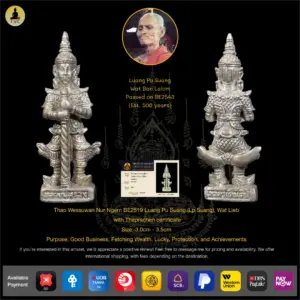
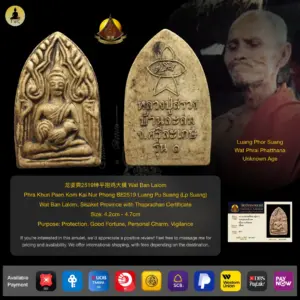
![[SOLD] Phra Khun Paen Thewada Song Kun Yai BE2519 Luang Pu Suang Wat Phrai Phatthana](https://tac-media.sgp1.digitaloceanspaces.com/2026/03/phra-khun-paen-thewada-song-kun-yai-be2519-luang-pu-suang-wat-phrai-phatthana-300x300.webp)
Biography
Who Was Luang Pu Suan (Yat Than Suan Chantharo)?
Luang Pu Suan (หลวงปู่สวน), full monastic name Yat Than Suan Chantharo (ญาท่านสวน ฉันทโร), was a revered Thai Buddhist monk born on 8 September BE 2453 (AD 1910) at Ban Na Tom, Ubon Ratchathani Province. He resided at Wat Na Udom (วัดนาอุดม), Talat Sum District, and was celebrated across the Mekong River basin as a supreme master of sacred takrut (ตะกรุด) inscription and a direct disciple of the legendary Somdet Lun lineage.
Early Life and Ordination
Luang Pu Suan (หลวงปู่สวน) was born on Friday, the 15th waxing day of the 10th lunar month, in the Year of the Dog, corresponding to 8 September BE 2453 (AD 1910). His birth name was Suan Saeng Khiao (สวน แสงเขียว). He was born at Ban Na Tom (บ้านนาทม), Tambon Kham Wa, Amphoe Talat Sum (อำเภอตาลสุม), Ubon Ratchathani Province (จังหวัดอุบลราชธานี). His father, named Khun (คูณ), was a native of Ban Samrong, while his mother, named Phui (ผุย), was from Ban Na Tom. The family earned their livelihood through rice farming, and Luang Pu Suan was one of eight siblings.
From childhood through his youth, he was known for a calm and gentle temperament, a generous and compassionate nature toward friends, and a depth of faith in Buddhism that surpassed his peers. At the age of 20, he sought his parents’ blessing to enter the monastic order. He was ordained at Wat Na Udom (วัดนาอุดม), Ban Na Tom, Amphoe Talat Sum, on 30 May BE 2473 (AD 1930). His preceptor (Upajjhaya) was Chao Athikarn Prohm Ma (เจ้าอธิการพรหมมา) of Wat Ban Rawe (วัดบ้านระเว), Tambon Sai Mun (now Tambon Rawe), Amphoe Phibun Mangsahan. Phra Di (พระดี) served as Kammavacajara (กรรมวาจาจารย์), and Phra Bua (พระบัว) served as Anusavanajara (อนุสาวนาจารย์). At ordination he received the Pali monastic title Chantharo (ฉนฺทโร).
Spiritual Development and Practice
Following his ordination, Luang Pu Suan (หลวงปู่สวน) devoted himself to intensive study of chanting and the Patimokkha (ปาติโมกข์) under Chao Athikarn Suan (เจ้าอธิการสวน), the then-abbot of Wat Na Udom, for approximately three years. He subsequently continued his education at Wat Ban Na Wa (วัดบ้านนาหว้า), Amphoe Talat Sum, for three months, before proceeding to Wat Ban Samrong Yai (วัดบ้านสำโรงใหญ่), Tambon Samrong — the ancestral home of his father — where Ajarn Mon Saeng Khiao (อาจารย์หม่อน แสงเขียว) served as abbot from BE 2478 (AD 1935).
His most transformative spiritual development came through his discipleship under two legendary masters of the Mekong basin tradition: Somdet Lun (สมเด็จลุน / สำเร็จลุน), also known as Luang Pu Somdet Lun, of Nakhon Champasak (นครจำปาสัก), Lao PDR — one of the most supernaturally revered monks in Theravada Buddhist history — and the great meditation master Yat Than Kammathan Phaeng (ญาท่านกรรมฐานแพง), another supremely accomplished adept of esoteric Dharma. From these two grand masters, Luang Pu Suan absorbed the full depth of sacred knowledge: intensive meditation to develop mental power (พลังจิต), the creation of protective charms, the inscription of sacred takrut scrolls, the preparation of sacred powders, and an array of esoteric sciences. Yat Than Kammathan Phaeng is said to have transmitted every secret technique to Luang Pu Suan without reservation, recognising his exceptional memory and rapid mastery. He was later honoured with the ecclesiastical title Phra Khru Athon Phatthana Khun (พระครูอาทรพัฒนคุณ) in BE 2517 (AD 1974), and elevated in rank in BE 2525 (AD 1982).
Major Amulet Consecrations and Ceremonies
Luang Pu Suan (ญาท่านสวน ฉันทโร) was most celebrated for his mastery of takrut (ตะกรุด) — inscribed sacred metal scroll amulets — which formed the centrepiece of his sacred craft tradition inherited from Somdet Lun and Yat Than Kammathan Phaeng. The following categories of sacred objects and amulet types are documented in Thai-language temple sources and devotee records as having been created by him:
- Takrut Ha Kasat (ตะกรุด ๕ กษัตริย์) — The “Five Kings” takrut, renowned for its properties of maha ut (มหาอุด, invulnerability to penetration), khlaeo khlat (แคล้วคลาด, evasion of danger), and kong kraphaan (คงกระพัน, physical invulnerability).
- Takrut Sai Rok Phra Phutthacha (ตะกรุดสายรกพระพุทธเจ้า) — A highly esoteric takrut of extreme rarity, directly connected to the Lord Buddha’s sacred lineage energy.
- Takrut Thon (ตะกรุดโทน) — A single-scroll takrut of concentrated power.
- Takrut Kap Raboet (ตะกรุด กับระเบิด) — A takrut believed to protect against explosive weapons and battlefield dangers.
- Takrut Upakhut (ตะกรุดอุปคุต) — Consecrated in the name of the great monk Upakhut (พระอุปคุต), renowned for spiritual protection.
- Takrut Salika Tom Wae (ตะกรุดสาลิกาตอมเหว่) — Considered the supreme takrut of metta (เมตตา, loving-kindness and charm), highly prized among collectors.
- Takrut Kai Khuen Rot Long Ra (ตะกรุดไก่ขึ้นรถลงรา) — A metta takrut specifically effective for trade, commerce, and attracting customers and good fortune.
- Takrut Khao Ta (ตะกรุดเข้าตา) — An exceptionally small takrut crafted from silver sourced from the mouth of a corpse cremated on a Tuesday (ngoen pak phi phao wan angkhan, เงินปากผีเผาวันอังคาร), small enough to be worn under the eyelid — a supreme esoteric artefact.
- Takrut Khlot Luk Ngai (ตะกรุดคลอดลูกง่าย) — A takrut consecrated to ease childbirth.
Beyond takrut, Luang Pu Suan was also accomplished in the creation of a wide range of sacred objects and esoteric practices, including:
- Pha Yan / Seua Yan (ผ้ายันต์ / เสื้อยันต์) — Sacred yantra cloths and yantra shirts.
- Luk Prakham Thon / Luk Om (ลูกปะคำโทน / ลูกอม) — Single sacred bead charms.
- Nang Kwak (รูปนางกวัก) — Beckoning Lady figures for wealth and good fortune.
- Palad Khik (ปลัดขิก) — Sacred phallic charms for luck and protection.
- Rahu Om Chan (ราหูอมจันทร์) — Rahu devouring the moon amulets for warding off misfortune.
- Si Phueng Maha Saneh (สีผึ้งมหาเสน่ห์) — Sacred beeswax charm for powerful attraction and charm.
- Sacred powders: Phong Itthi Chae (ผงอิทธิเจ), Phong Pathama (ผงปถมัง), and other divine powders of esoteric formulation.
- Consecrated sacred water (น้ำพระพุทธมนต์) with extraordinary secret methods.
- Ma Kin Chai (หมากินใจ / หมากินความคิด) — “The dog that consumes thought,” regarded as one of the supreme metta sciences.
- Fang Khem Dam (ฝังเข็มดำ) — The “Black Needle Implantation” ritual, the supreme science of physical invulnerability and protection against all forms of weapons. Very few monks possess, let alone successfully transmit, this knowledge.
Detailed batch records with specific BE years, batch names, and material inventories for formally issued amulet editions are not widely documented in English sources. Collectors and researchers seeking precise consecration ceremony records are advised to consult Thai-language temple sources, devotee networks in Ubon Ratchathani, and specialist Thai amulet publications covering the Mekong basin tradition.
Legacy and Temple Significance
Wat Na Udom (วัดนาอุดม), located in Amphoe Talat Sum (อำเภอตาลสุม), Ubon Ratchathani Province (จังหวัดอุบลราชธานี), stands as one of the spiritually significant temples of the northeastern Thai Mekong River basin, its prestige elevated enormously by the presence and works of Luang Pu Suan (ญาท่านสวน ฉันทโร). As a monk of the Somdet Lun lineage — one of the most revered esoteric Buddhist lineages across Thailand and Laos — Luang Pu Suan carried forward a tradition of sacred knowledge that is considered rare and of the highest calibre.
His legacy rests on his boundless compassion (metta barami, เมตตาบารมี): he was known never to refuse anyone who came to him in distress, regardless of social class or background, and he observed the Vinaya (พระธรรมวินัย) with scrupulous discipline. Devotees recall his serene, ever-smiling countenance as a visible reflection of his inner attainment. His contributions to temple development — most notably the construction of the Sala Kan Prien (ศาลาการเปรียญ) at Wat Ban Samrong Yai — left lasting physical monuments to his service to the Sangha. Among collectors across Thailand, Laos, and the broader Theravada world, his sacred takrut and esoteric amulets are venerated as genuine transmissions of the Mekong basin’s most powerful protective and metta traditions.