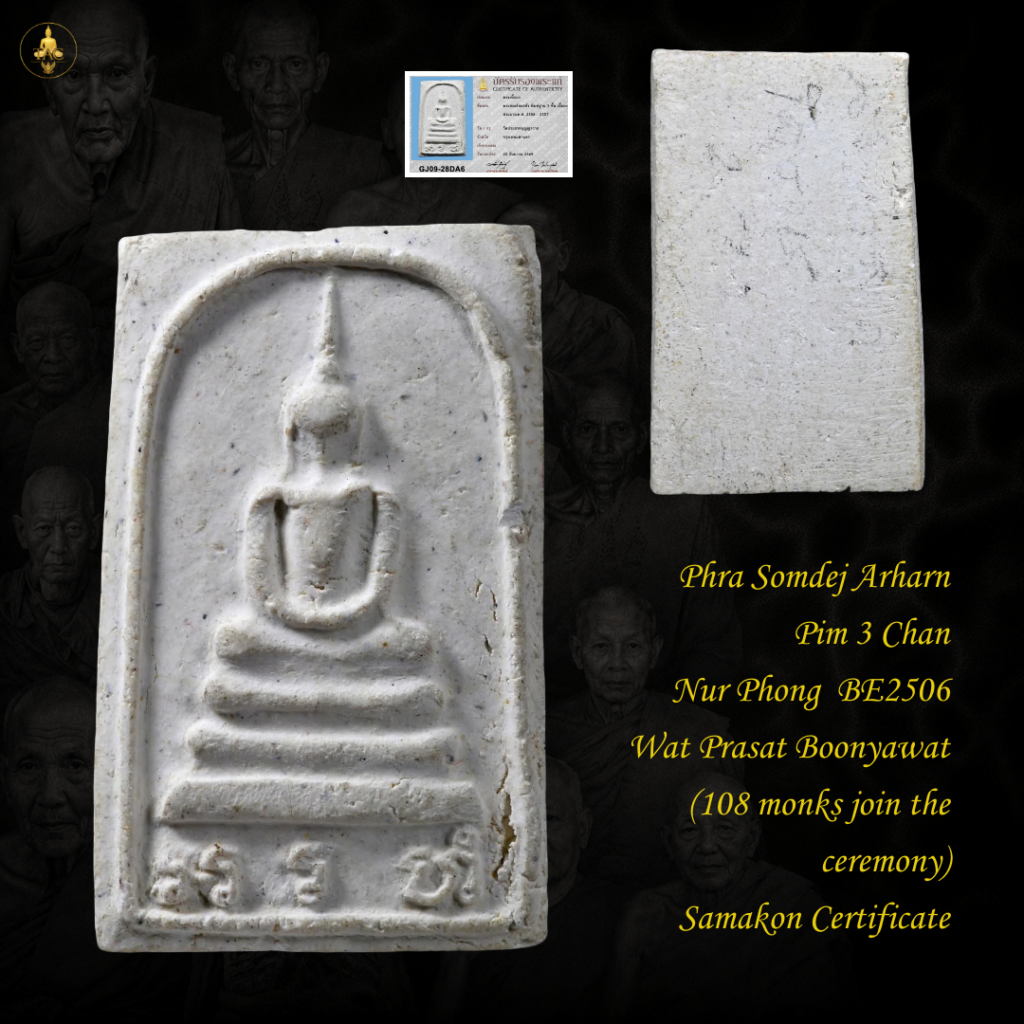
Phra Somdej Arharn Pim 3 Chan Nur Phong BE2506 Wat Prasat Boonyawat (108 monks join the ceremony)
| Type | Phra Somdej Arharn Pim 3 Chan |
| Temple | Wat Prasat |
| B.E. Year | 2506 |
| Material | Nur Phong |
| Condition | Very Good |
| Certificate | Samakom |
| SKU | TAC-PhraSomdejArharnPim3Chan--001 |
Authentic Phra Somdej Arharn Pim 3 Chan, Wat Prasat Boonyawat BE 2506. Nur Phong. Samakon certified. Trusted Thai amulet Singapore dealer.
What is the Phra Somdej Arharn Pim 3 Chan from Wat Prasat Boonyawat?
The Phra Somdej Arharn Pim 3 Chan is an authentic Thai amulet produced at Wat Prasat Boonyawat in Buddhist Era 2506, crafted from sacred Nur Phong (sacred powder) composition. Certified by the Samakon, this three-tiered throne-mould Phra Somdej represents a significant classical-era devotional piece highly regarded by collectors across Southeast Asia and Greater China.
BE 2506 (1963 CE) falls within one of the most celebrated decades of Thai amulet production — a golden era when monastic craftsmanship and sacred consecration rituals reached remarkable refinement. Amulets produced during this period are consistently sought after by serious collectors for their historical integrity and deeply rooted spiritual significance.
Wat Prasat Boonyawat’s role in producing the Phra Somdej Arharn Pim 3 Chan places this piece firmly within the mainstream of mid-twentieth-century Thai Buddhist devotional art. The Pim 3 Chan (three-tiered throne) mould design is one of the most recognisable and revered formats in the Phra Somdej family, distinguished by its layered stepped base that references the celestial throne of the Buddha.
Phra Somdej Arharn Pim 3 Chan and Wat Prasat Boonyawat Heritage
Wat Prasat Boonyawat is the originating temple of this Phra Somdej Arharn Pim 3 Chan, and its monastic community was instrumental in overseeing the creation and consecration of this BE 2506 batch. Temples in Thailand’s amulet-producing tradition have historically served as both spiritual and custodial centres for sacred object production, ensuring that ritual standards were upheld throughout the process.
The broader Thai Buddhist amulet tradition is rooted in centuries of Theravada monastic practice, whereby monks and abbots channel meditative merit into consecrated objects for the benefit of devotees. Wat Prasat Boonyawat’s participation in this tradition during the mid-BE 2500s reflects the temple’s active engagement with established Thai Buddhist liturgical customs.
For collectors in Singapore, Malaysia, and Greater China, provenance tied directly to a named temple — particularly one with a documented production record from BE 2506 — significantly strengthens an amulet’s authenticity profile. The Wat Prasat Boonyawat origin of this Phra Somdej Arharn Pim 3 Chan is a key factor in its collectibility and its standing among Samakon-certified pieces.
Nur Phong Phra Somdej Arharn Pim 3 Chan — Composition and Craftsmanship
Nur Phong, the material of this Phra Somdej Arharn Pim 3 Chan, translates directly as “sacred powder mass” — a compound medium central to the Phra Somdej amulet tradition. Nur Phong compositions typically incorporate powdered limestone or shell, dried floral offerings, sacred earth from revered sites, and consecrated herbal and mineral elements blended under strict ritual conditions.
The precise binding and pressing of Nur Phong into the Pim 3 Chan mould requires skilled artisanal technique to ensure that the three-tiered stepped throne base retains its definition and that the seated Buddha image at the centre emerges with clarity. Well-pressed examples from BE 2506 typically show clean mould lines and a firm, dense powder body that has aged gracefully over the decades.
Over time, authentic Nur Phong amulets develop a characteristic surface patina — subtle tonal shifts and natural micro-texturing — that experienced collectors recognise as evidence of genuine age. This natural ageing process, combined with the original sacred ingredient composition, is part of what distinguishes an authentic Nur Phong Phra Somdej Arharn Pim 3 Chan from later reproductions.
Spiritual Benefits of Phra Somdej Arharn Pim 3 Chan from Wat Prasat Boonyawat
The Phra Somdej category of amulets is traditionally venerated across Thailand and among diaspora communities in Singapore, Malaysia, and Hong Kong for its association with the Buddha’s highest teaching and protective grace. Devotees regard the Phra Somdej Arharn Pim 3 Chan as a spiritually potent companion, with the three-tiered throne symbolising the Triple Gem — the Buddha, the Dhamma, and the Sangha.
Collectors and devotees who revere this amulet commonly associate it with the following blessings, understood within Thai Buddhist folk tradition:
- Protective Blessing: Regarded by devotees as a source of spiritual protection against misfortune and harm during daily life and travel.
- Spiritual Growth: Traditionally venerated by practitioners seeking to deepen their Buddhist practice and cultivate inner merit.
- Charisma & Influence: Collectors associate the Phra Somdej format broadly with Metta (loving-kindness) energy, said to promote goodwill and harmonious relations in personal and professional spheres.
Phra Somdej Arharn Pim 3 Chan BE 2506 — Authentication and Collector Value
This Phra Somdej Arharn Pim 3 Chan BE 2506 carries certification from the Samakon — the Thai amulet collector association recognised as one of the primary authentication bodies for classical Thai amulets. Samakon certification involves panel review by experienced examiners who assess material composition, mould characteristics, surface ageing, and provenance consistency.
For collectors in Singapore and across Southeast Asia, Samakon certification on a mid-BE 2500s Nur Phong Phra Somdej is a meaningful assurance of authenticity. Certified examples from this era are increasingly difficult to source in the open market, and pieces with intact documentation command stronger collector confidence.
The combination of a named temple origin (Wat Prasat Boonyawat), a historically significant production year (BE 2506), a traditional Nur Phong medium, and Samakon certification makes this Phra Somdej Arharn Pim 3 Chan a well-rounded acquisition for both devotional use and long-term collection building.
This Phra Somdej Arharn Pim 3 Chan from Wat Prasat Boonyawat, produced in BE 2506, is a well-documented classical Nur Phong piece carrying Samakon certification — the combination of named temple provenance, a historically significant production year, and panel-verified authentication makes this a credible addition to any serious collection. For collectors in Singapore and the region seeking a certified mid-BE 2500s Phra Somdej with clear lineage, this piece merits close consideration.
Attributes reflect Thai Buddhist devotional tradition and are not measurable claims.