Phra Bucha Jatukam Ramatep Nur Thong Archan Lek BE2550 Wat Mahathat
| Temple | Wat Mahathat |
| B.E. Year | 2550 |
| Material | Thong |
| SKU | TAC-0367 |
Phra Bucha Jatukam Ramatep Roon Udomchok Pathom Arahan Matuphum • Cast Metal Alloy BE2550 / CE2007 • Wat Phra Mahathat Woramahawihan, Nakhon Si Thammarat • Consecrated in the sacred precinct of the Great Stupa under Phutt
Phra Bucha Jatukam Ramatep Roon Udomchok Pathom Arahan Matuphum • Cast Metal Alloy
BE2550 / CE2007 • Wat Phra Mahathat Woramahawihan, Nakhon Si Thammarat • Consecrated in the sacred precinct of the Great Stupa under Phutthaphisek rites guided by Archan Lek Chanthip • Jatukam Ramatep prosperity and protection lineage; Roon Udomchok Pathom Arahan Matuphum
Overview: Phra Bucha Jatukam Ramatep (พระบูชาจตุคามรามเทพ) — Roon Udomchok Pathom Arahan Matuphum — Cast metal alloy (antique-bronze finish) — BE2550 / CE2007 — Wat Phra Mahathat Woramahawihan, Nakhon Si Thammarat — guided by Archan Lek Chanthip — height 11.5 inches × width 6.5 inches.
What This Piece Represents (Collector Lens)
The Phra Bucha (พระบูชา — altar worship image) is a distinct category within Thai Buddhist material culture that operates differently from wearable amulets. Where a small pendant amulet travels with the devotee and is oriented toward personal protection and daily interaction with the world, a Bucha is stationary by design — it anchors a domestic altar, a shop counter, or a personal workspace and becomes the focal point of a daily practice of offering, chanting, and merit-making. In Thai devotional understanding, the Bucha “holds the space” rather than follows the individual; its role is guardianship of the household or commercial environment and the cultivation of the moral and spiritual conditions that, in traditional belief, underpin sustainable prosperity. For the collector, the Phra Bucha dimension also means the piece will be assessed visually at close quarters and at rest — proportional balance, sculptural resolution, and the quality of the surface finish become primary criteria rather than size for wearability.
This particular release — the Roon Udomchok Pathom Arahan Matuphum — is distinguished by the purposefulness of its naming. Roon (รุ่น — batch or edition) designates the specific issue within the Jatukam Ramatep production sequence at Wat Phra Mahathat Woramahawihan; Udomchok (อุดมโชค) translates as “abundant auspicious fortune”; Pathom Arahan (ปฐมอรหันต์) points toward the purity and moral integrity of the first enlightened disciples; and Matuphum (มาตุภูมิ) frames the piece as rooted in a sacred homeland — evoking the specific spiritual geography of Nakhon Si Thammarat as the origin-ground of the Jatukam Ramatep tradition. Taken together, the three-part name sets a clear “spiritual programme” for the batch: not only the seeking of fortune, but its right pursuit — through clean conduct, spiritual rootedness, and alignment with the purity lineage of the earliest Theravada practitioners.
Amulet Information
Name: Phra Bucha Jatukam Ramatep Roon Udomchok Pathom Arahan Matuphum (พระบูชาจตุคามรามเทพ รุ่นอุดมโชค ปฐมอรหันต์ มาตุภูมิ)
Material: Cast metal alloy — antique-bronze toned finish; 11.5 × 6.5 inches
Year: BE2550 / CE2007
Temple: Wat Phra Mahathat Woramahawihan (วัดพระมหาธาตุวรมหาวิหาร), Nakhon Si Thammarat
Province: Nakhon Si Thammarat
Monk: Archan Lek Chanthip (อาจารย์เล็ก จันทิพย์) — presiding ritual guidance for this Bucha release
Lineage Note: Jatukam Ramatep prosperity and protection lineage; consecrated in the sacred precinct of the Great Stupa, Wat Phra Mahathat Woramahawihan; Roon Udomchok Pathom Arahan Matuphum batch; BE2550 later-phase revival period
SKU: TAC-ArcLeKChanthip-JatukamBuchaUdomchok-001
Price:
SGD 368
History & Lineage — Phra Bucha Jatukam Ramatep Roon Udomchok Pathom Arahan Matuphum (Wat Phra Mahathat Woramahawihan)
Jatukam Ramatep (จตุคามรามเทพ) is a Thai Buddhist protective deity figure whose devotional tradition is centred on Nakhon Si Thammarat province in southern Thailand. The figure’s origins are linked to two ancient guardian spirits of the city pillar of Nakhon Si Thammarat — identified in local legend as Jatukam and Ramatep — who came to be venerated as a combined deity of protection and prosperity through the efforts of the Nakhon Si Thammarat police community and senior spiritual advisors from the 1980s onward. The decisive propagation of the Jatukam Ramatep amulet tradition is most closely associated with Police Colonel Khun Phan (Khun Phanthaarak Ratchadet) and with the spiritual authority of Wat Phra Mahathat Woramahawihan, whose Great Stupa (พระบรมธาตุ) is the oldest and most revered sacred monument in southern Thailand, believed to contain relics of the historical Buddha. The association between Jatukam Ramatep and this particular temple is therefore not merely locational — it is foundational: the deity’s legitimacy and the protective power attributed to amulets produced in its name is understood by the tradition to derive from the relic-sanctified environment of the Great Stupa precinct.
The Jatukam Ramatep revival period reached its peak intensity around BE2549–2550 (CE2006–2007), a phase during which demand among collectors and devotees across Thailand, Singapore, Malaysia, Taiwan, and Hong Kong created an unprecedented market for new editions. BE2550 sits in the later phase of this period — a moment when the initial frenzy had begun to clarify and collectors were increasingly prioritising editions with substantive temple provenance and named spiritual guidance over generic commemorative issues. This Roon Udomchok Pathom Arahan Matuphum was produced in that context: a deliberately purposeful edition anchored to the Great Stupa environment and overseen by Archan Lek Chanthip, whose ritual guidance role gave the consecration process a named spiritual referent beyond the institutional temple identity alone.
Archan Lek Chanthip (อาจารย์เล็ก จันทิพย์) is a practitioner associated with the Nakhon Si Thammarat devotional network, involved in the ritual preparation and consecration guidance of Jatukam Ramatep editions during the revival period. In the context of this Bucha release, the guidance role connotes oversight of the consecration protocol — ensuring that the Phutthaphisek ceremony was conducted with the correct invocations, meditative intention, and ritual sequencing appropriate to a large-format altar image intended for household and commercial veneration. The involvement of a named ritual practitioner in a Bucha edition is a meaningful collector reference point because it provides a traceable human anchor for the consecration record, distinguishing the piece from anonymously produced altar images.
About the Material — Cast Metal Alloy Composition
The choice of cast metal alloy for a Phra Bucha is a deliberate one in the Thai devotional tradition. Where powder-press tablets and small flat amulets use Nur Phong compositions, and pendant amulets of recent decades have diversified across gold, silver, and copper alloys, the Bucha altar image format has consistently gravitated toward cast bronze and bronze-toned metal alloys because the medium communicates permanence, weight, and institutional gravity. A cast metal Bucha placed on an altar carries a visual and tactile quality — the warmth of antique-toned bronze, the settled density of the figure on its base — that plastic or ceramic equivalents do not replicate. For a piece intended to anchor daily ritual practice across years or decades, material durability and the visual authority of the cast-metal tradition are primary functional requirements.
- Cast metal alloy body: The solid casting technique produces a figure with meaningful weight and structural stability on the altar surface — a physical “settledness” that collectors and practitioners consistently describe as appropriate to the guardianship role of the Bucha format; the weight also functions as a practical authentication reference, as lightweight hollow-cast reproductions are identifiable by handling.
- Antique-bronze toned finish: The warm reddish-brown surface treatment references the classical Thai Buddhist image-casting tradition and conveys the visual vocabulary of longevity and institutional dignity; over time, areas of regular veneration-contact develop their own natural patina variation, which experienced collectors regard as evidence of genuine ongoing altar use.
- Scale (11.5 × 6.5 inches): The proportions are calibrated for serious altar placement — large enough to serve as a primary focal point on a domestic or commercial altar, commanding visual presence without overwhelming a standard Thai household shrine space; this scale also provides sufficient surface area to render the sculptural programme of the Jatukam iconography at meaningful detail resolution.
Design / Pim / Variant Notes
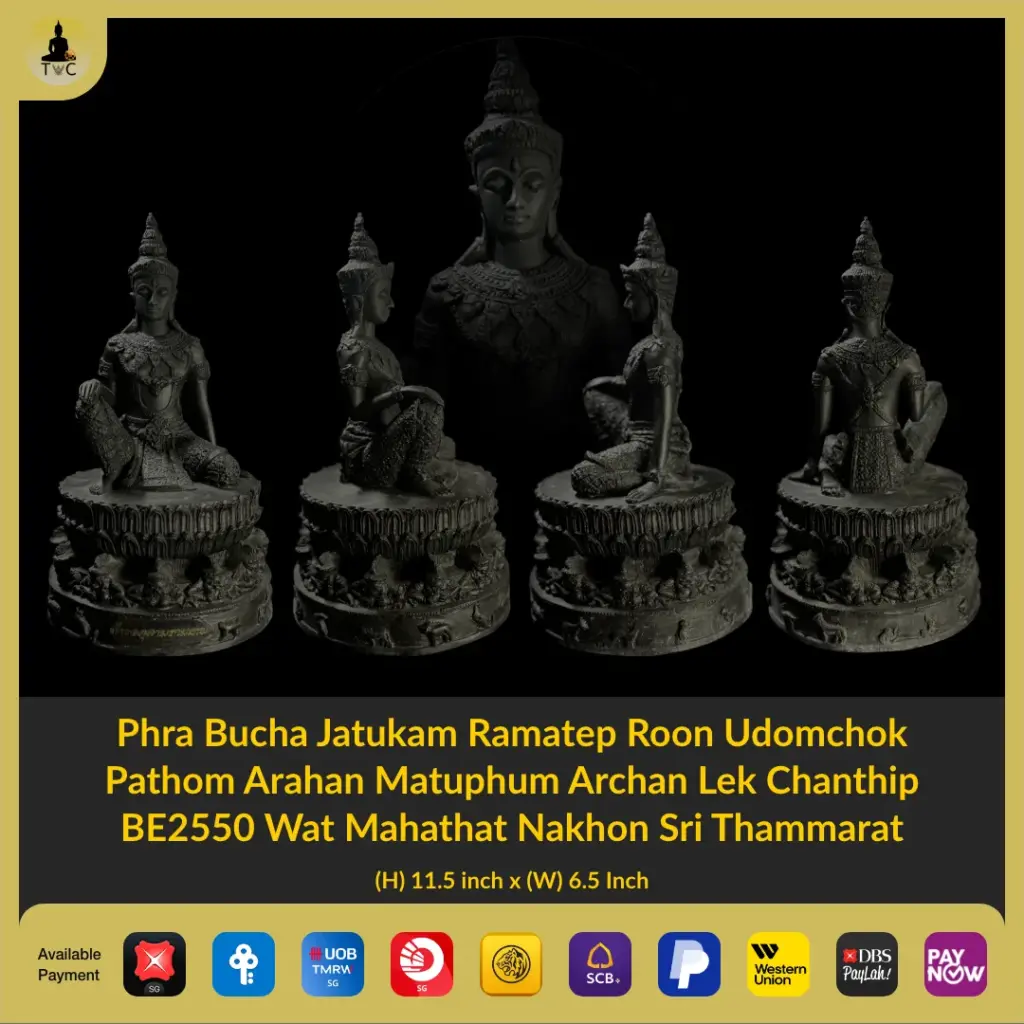
The Jatukam Ramatep figure in Bucha format is presented in a formal seated posture on a lotus base — the iconographic language of stable, enthroned guardianship rather than active movement. The figure typically bears royal or divine ceremonial regalia: crown or headdress elements, shoulder ornamentation, and formal robing consistent with the deity’s identity as a guardian of royal and civic order. In the Roon Udomchok Pathom Arahan Matuphum design, the overall visual impression is what collectors describe as “temple-formal” — dignified, composed, and oriented toward respectful altar placement rather than the more commercially styled mass-market Jatukam figurines produced during the revival peak. Collector assessment of a Bucha in this format focuses on four criteria: proportional balance between the figure’s upper body and the lotus base; the crispness and resolution of the ornamental detailing in the crown and shoulder elements; the consistency of the surface finish across the relief; and the quality of the base finishing, which in well-executed editions integrates cleanly with the figure above it. The antique-bronze tone is applied to communicate traditional gravitas; where the finish is even and well-settled into the sculpted relief, it is a positive condition indicator.
Traditional Spiritual Attributes & Metaphysical Properties
In Thai Buddhist and Brahmanical devotional culture, Jatukam Ramatep is approached as a guardian deity whose protective and prosperity-conferring attributes are activated through right relationship — meaning that the effectiveness of the piece, in traditional belief, is understood to depend not only on the consecration but on the quality of the devotee’s daily practice before it. For a Bucha, this relational dimension is explicit: devotees are expected to maintain the altar, offer water and flowers regularly, practice generosity, and keep truthful conduct as conditions for the protective and prosperity functions to operate. This framing distinguishes the Bucha tradition from a transactional amulet-wearing model and situates the piece as a tool of moral cultivation as much as a protective object. The Roon Udomchok Pathom Arahan Matuphum batch name reinforces this explicitly through the Pathom Arahan element — pointing toward the purity of the first enlightened disciples as the moral standard toward which right practice aspires.
- โชคลาภ (Chok Lap — Auspicious Fortune & Prosperity): The primary material aspiration associated with Jatukam Ramatep in Thai devotional culture; the Udomchok element of this batch name specifically amplifies this attribute, framing the edition as an abundant-fortune issue — traditionally approached for better opportunity flow in business, investment, and livelihood contexts.
- แคล้วคลาด (Klaew Klaad — Evasion of Harm & Safe Passage): The protective dimension of Jatukam Ramatep, rooted in the deity’s identity as a guardian of city and home; for Bucha placement, this attribute is understood as a pervasive protective presence over the household or commercial space rather than person-specific protection.
- มาตุภูมิ (Matuphum — Sacred Homeland Rootedness): The third element of the batch name functions as both a devotional and cultural anchor; in traditional belief, a piece rooted in the Nakhon Si Thammarat spiritual geography — and specifically in the Great Stupa precinct of Wat Phra Mahathat Woramahawihan — carries the accumulated merit of the oldest relic-site in southern Thailand, which is understood to deepen and stabilise all other attributed functions.
Rarity & Collector Significance — Phra Bucha Jatukam Ramatep BE2550
The collector assessment framework for BE2550 Jatukam Ramatep Bucha pieces differs from that applied to ancient or single-monk amulets. Because the revival period produced large volumes, rarity is evaluated primarily through the specificity of batch identity, the named spiritual guidance, and the temple provenance — with condition and completeness serving as secondary differentiation factors. On all three primary criteria, this edition is well-positioned: the Roon Udomchok Pathom Arahan Matuphum designation provides a clearly documented batch identity within the broader BE2550 production sequence; Archan Lek Chanthip’s guidance role provides a named ritual referent that most anonymously produced Jatukam pieces lack; and the Wat Phra Mahathat Woramahawihan Great Stupa consecration environment is the single most prestigious site-association available within the Jatukam Ramatep tradition. As the broader market for BE2550-era Jatukam pieces has matured — with early speculative interest having given way to a more discerning collector community — editions with all three of these qualities intact have maintained their significance as reference-grade examples of the revival period’s more intentionally produced altar images. The 11.5-inch scale is also noteworthy: large-format Bucha pieces in good condition and with complete finish integrity are less commonly encountered than small wearable pendants from the same period, as their altar placement history makes condition more variable.
Conclusion
The Phra Bucha Jatukam Ramatep Roon Udomchok Pathom Arahan Matuphum BE2550 is a purposefully conceived altar image that brings together the foundational site-authority of Wat Phra Mahathat Woramahawihan’s Great Stupa, the named spiritual guidance of Archan Lek Chanthip, and a batch name that sets a specific threefold doctrinal intention: abundant fortune, the purity of right conduct, and rootedness in the tradition’s sacred homeland. For collectors in Singapore, Malaysia, Taiwan, and Hong Kong who approach Jatukam Ramatep with historical seriousness, this piece represents a well-documented BE2550 edition with clear provenance anchors and the substantive altar presence appropriate to its format. For devotees, it offers a daily companion for the practice of generosity, moral steadiness, and the patient cultivation of the conditions that the tradition associates with sustainable prosperity.
Front face — Phra Bucha Jatukam Ramatep (พระบูชาจตุคามรามเทพ) — seated posture on lotus base — royal ceremonial crown and regalia detail — cast metal alloy, antique-bronze finish — BE2550 / CE2007
Side view — sculptural depth, shoulder ornament detail, and antique-bronze finish tone — condition reference for relief crispness and surface consistency
Three-quarter view — overall silhouette and base integration — proportional balance between figure and lotus pedestal; back detailing visible
Rear view — back panel detailing and base finish — cast edge quality reference; overall silhouette and altar footprint at 11.5 × 6.5 inches
Attributes reflect Thai Buddhist devotional tradition and are not measurable claims.