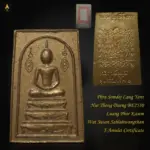
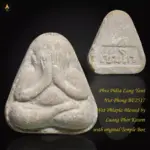
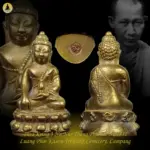
Rian Apple Luang Phor Kasem (Lp Kasem) Nur Thong Daeng BE2517 Trilak Cemetery, Lampang
| Type | Rian |
| Monk | Luang Phor Kasem Trailak Cemetery, Lampang |
| B.E. Year | 2517 |
| Material | Thong Daeng |
| SKU | TAC-0127 |
Authentic Rian Apple by Luang Phor Kasem Trailak Cemetery, Lampang. Thong Daeng, BE 2517, Thaprachan certified. Available now from TAC, Singapore.
What is the Rian Apple by Luang Phor Kasem Trailak Cemetery, Lampang?
The Rian Luang Phor Kasem Trailak Cemetery, Lampang — specifically the “Apple” format — is a Thong Daeng (copper alloy) medallion pressed in BE 2517, attributed to Luang Phor Kasem Trailak Cemetery, Lampang and associated with Trilak Cemetery, Lampang. It carries a Thaprachan certificate and is recognised by its rounded, apple-like perimeter.
Luang Phor Kasem and why Trilak Cemetery matters to collectors
Luang Phor Kasem Khemako spent much of his monastic life at Trilak Cemetery in Lampang — a setting chosen deliberately for its solitude. That environment is not incidental. For collectors across the region, it shapes how his amulets are understood: objects tied to a monk who lived plainly, kept precepts strictly, and made no spectacle of his practice.
His releases are not loud pieces. The Apple format captures that character well — compact, unadorned, suited to daily wear rather than display. Devotees often describe the Kasem tradition in the language of metta (loving-kindness) and mindfulness rather than dramatic protection. That framing has built a loyal following in Singapore, Malaysia, Taiwan, and Hong Kong, where collectors tend to favour pieces with a clear, disciplined backstory.
For a broader grounding in how medallions like this sit within the wider practice, the Thai Buddhist amulet tradition covers the ritual and cultural context well.
The nuea, the pim, and what makes this edition read right
This piece is pressed in nuea Thong Daeng — copper alloy that ages with real honesty. The recesses darken first; the high points warm to a reddish-brown over time. That natural progression is part of what collectors look for. Forced polishing flattens the contrast and removes the aged copper warmth that signals a piece has been worn and kept, not stored and buffed.
The “Apple” pim (mould) is identified by its rounded, slightly bulbous perimeter — different from the oval or shield shapes in other Kasem editions. Authentication points worth checking:
- Facial line clarity — a confident strike shows clean definition around the eyes and brow.
- Edge contour — consistent curve all the way around; uneven edges can indicate a cast reproduction.
- Lettering sharpness — crisp characters, not smeared or soft.
- Patina character — gentle smoothing on contact points is expected; harsh abrasions usually mean mishandling.
This listing comes with a Thaprachan certificate, which provides an independent reference point for authentication. Thaprachan certification is well-regarded among serious collectors in this market as a baseline for provenance.
Wearing and caring for a Thong Daeng medallion
Collectors who wear Kasem pieces daily generally keep them simple — no aggressive cleaning, no chemical exposure. Natural patina is part of the piece’s history, not a flaw to correct. Sweat pooling over time can accelerate corrosion unevenly, so a dry wipe after wear is worth the habit.
Traditionally, the Rian Apple is carried for calm protection and steady decision-making. The association is not with sudden fortune but with a quieter kind of assurance — the kind that fits a monk whose teaching was about conduct and steadiness rather than dramatic intervention. Whether worn in a pendant setting or kept in a cloth pouch, the piece is compact enough for everyday use without being conspicuous.
We at TAC are offering this Rian Apple in Thong Daeng from BE 2517, associated with Luang Phor Kasem Khemako of Trilak Cemetery, Lampang — one of the more understated formats in the Kasem line, and one that wears well for that reason. The piece comes with a Thaprachan certificate, which gives a collector in this market a solid reference point without having to rely on seller word alone. For a collector wanting a daily-wear Kasem piece with documented certification and a clear pim identity, this Apple format is a practical and honest choice.
Attributes reflect Thai Buddhist devotional tradition and are not measurable claims.