Chapter 01
A part of everyday Thai life
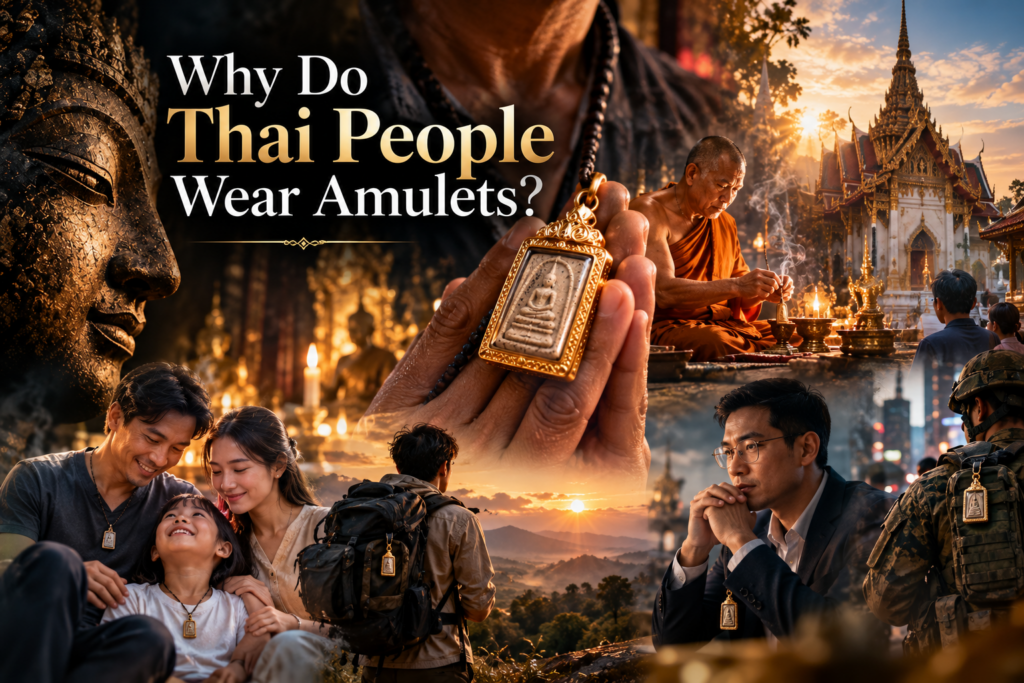
Why do thai people wear amulet? Walk through any Thai city and you'll see them everywhere — a monk's image on a taxi driver's mirror, a pendant under a market trader's shirt, a chain of amulets on a soldier heading to post. Almost every Thai Buddhist owns at least one, and many wear several at once. For most Thais, an amulet isn't an occasional accessory; it's a quiet, daily companion (if you're new to them, start with what a Thai amulet is).Chapter 02
What they're believed to bring
People don't wear amulets to show off — they wear them for what the piece is believed to carry. The reasons cluster into a few familiar hopes:- Protection — safety from accidents, harm and bad luck.
- Metta — loving-kindness: warmer relationships and goodwill from others.
- Fortune — support in business, trade and career.
- Calm — a steadier mind and a reminder to live well.
Chapter 03
Protection, above all
If there's one reason that runs deeper than the rest, it's protection. Thai has specific words for it — klaew klaad, the narrow escape from danger, and kong grapan, resilience against harm. It's why soldiers, police, taxi drivers and anyone whose day carries risk so often wear a trusted piece close. The amulet is worn less as a guarantee and more as a steadying presence — something to carry into an uncertain world.Chapter 04
Respect for the monk behind it
Here's a point outsiders often miss: Thais don't worship the amulet itself. The piece is respected as a link to the barami — the accumulated virtue and spiritual standing — of the monk who blessed it. A revered master's blessing is what gives an amulet its meaning, which is why the name behind a piece matters so much to collectors. Wearing it is a way of keeping that virtue close, and of being reminded to live up to it.Chapter 05
A link to the temple and to merit
Amulets also tie a person to the temple. Traditionally you don't "buy" an amulet — you invite or rent it, and the offering supports the temple's work. In that sense, wearing one is an act of devotion and merit-making as much as of protection. It keeps a small, personal thread connected to the sacred, even in the middle of an ordinary working day.Chapter 06
More than belief — reassurance and identity
Ask many Thais why they wear an amulet and the honest answer is partly cultural, partly personal. There's real comfort in carrying something blessed: a touch of confidence before a difficult day, a sense of calm, a reminder of who you want to be. It's also a thread of identity — a connection to family, faith and a tradition centuries deep. For a great many people, that steadying intention is the true value, whatever else they hope the piece brings.Chapter 07
Who wears them
Everyone, really. Amulets cross every line in Thai society — farmers and executives, soldiers and celebrities, the deeply devout and the casually faithful. Famous monks are sought after by generals and business tycoons alike; a prized piece can pass through collectors for decades. It isn't a niche practice or a superstition of the few — it's woven through the whole culture.Chapter 08
Do you have to be Buddhist?
No. While the mainstream tradition is Buddhist, Thai-Chinese communities wear amulets widely, and collectors around the world are drawn to them for their craft, history and meaning. You don't need to belong to any particular faith to wear one with respect — you only need to approach it, as Thais do, as something meaningful rather than merely decorative. If you'd like help choosing a piece that fits you, our My Destiny Amulet reading is a thoughtful place to start, and our guide to choosing and authenticating a Thai amulet walks you through the rest.Chapter 09
In closing
Thais wear amulets for protection, for fortune, for warmth in their dealings with others, and for the quiet reassurance of carrying something blessed. Underneath all of it is respect — for the monk behind the piece, for the temple it came from, and for a tradition that has accompanied everyday life for generations. When you're ready to find your own, browse our pieces and ask us anything.Chapter 10
Frequently Asked Questions
Why do Thai people wear amulets?
Mainly for protection, good fortune, loving-kindness in their relationships, and a calmer mind — and out of respect for the monk whose blessing gives each piece its meaning. For most Thais it's a daily part of life, not an occasional accessory.Do Thai people worship the amulet itself?
No. The amulet is respected as a link to the barami — the virtue and spiritual power — of the monk who consecrated it, and as a reminder to live well. It's not treated as an idol in its own right.What is the main reason Thais wear amulets?
Protection is the deepest reason — the qualities Thais call klaew klaad (a narrow escape from danger) and kong grapan (resilience against harm). It's why people in risky work so often wear a trusted piece close.Do you have to be Buddhist to wear a Thai amulet?
No. The tradition is mainly Buddhist, but Thai-Chinese communities and collectors worldwide wear them too. What matters is approaching the piece with respect rather than treating it as mere decoration.How many amulets do Thai people wear?
Often more than one — it's common to see several pieces worn together on a single chain, each chosen for a different purpose such as protection, fortune or metta.Dealer's Note — Thai Amulets Collection has shared and sold authentic Thai amulets from Singapore since 2015. We're always glad to explain the meaning and history behind any piece, and to help you choose one to wear with respect — just message us on WhatsApp.