A miraculous powers of Phra Kring Phairi Phinash amulet by Luang Pu Awan Pakuno
Discover the miraculous powers of Phra Kring Phairi Phinash amulet by Luang Pu Awan Pakuno — history, origin, collector value, and authentication guide for Singapore collectors.
What is A miraculous powers of Phra Kring Phairi Phinash amulet by Luang Pu Awan Pakuno?
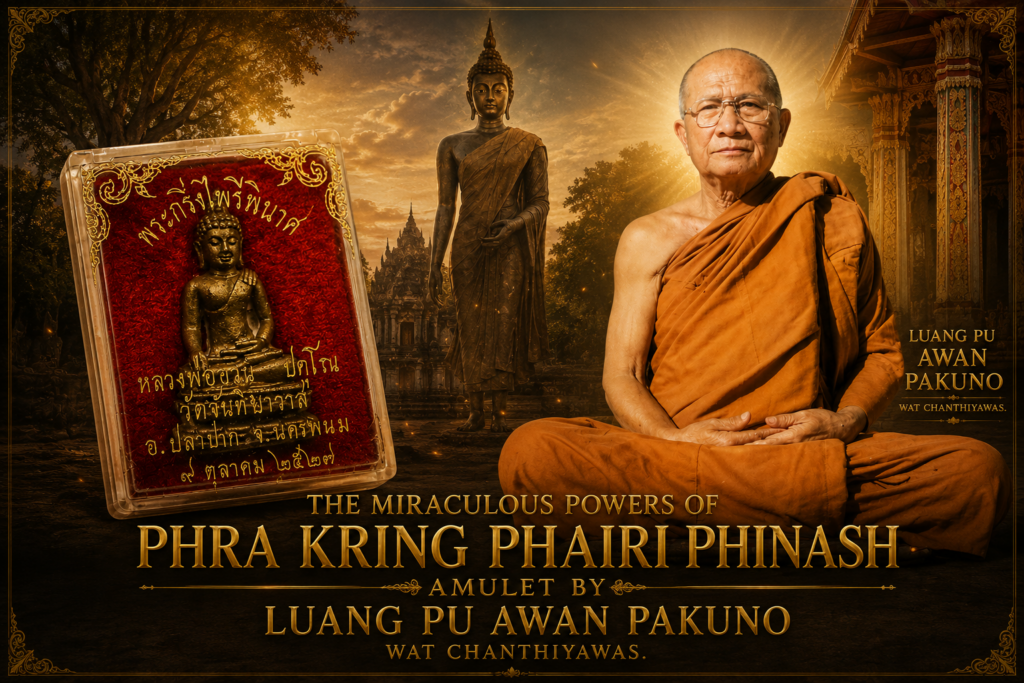
The miraculous powers of Phra Kring Phairi Phinash amulet by Luang Pu Awan Pakuno refer to the protective and enemy-vanquishing attributes associated with this modern Thai Buddhist amulet, consecrated at Wat Chanthiyawas, Nakhon Phanom Province. Collectors across Singapore and Southeast Asia actively seek this amulet for its documented devotee testimonials and its full name — Phra Kring Yai Phairi Phinash — meaning “Great Amulet that Destroys Enemies.”
Luang Pu Awan Pakuno served as the former abbot of Wat Chanthiyawas, located in Village No. 10, Namakheua Subdistrict, Pla Pak District, Nakhon Phanom Province. He was widely revered as a monk of exemplary conduct and was a direct disciple of Luang Pu Kinaree Chanthiyo, a lineage that lent his consecrations particular spiritual authority within the Thai Buddhist tradition.
The Phra Kring Phairi Phinash amulet sits firmly within the modern era of Thai amulet history, consecrated in BE 2527 (AD 1984). Its reputation spread through first-hand devotee accounts, most notably a sworn testimony by Mr. Phon Boonbua dated December 4, 1984 — one of the most detailed and specific miracle narratives recorded in contemporary Thai amulet collector literature.
Origins and Historical Context of A miraculous powers of Phra Kring Phairi Phinash amulet by Luang Pu Awan Pakuno
The Phra Kring Phairi Phinash amulet originates from Wat Chanthiyawas, a temple situated in Nakhon Phanom Province in northeastern Thailand — a region historically rich in forest monk traditions and powerful Dhamma masters.
Luang Pu Awan Pakuno was not only the abbot of Wat Chanthiyawas but also a student of Luang Pu Kinaree Chanthiyo, placing him within a respected lineage of northeastern Thai monks known for their strict vinaya observance and mastery of sacred sciences. This disciplic succession is central to understanding why his amulets command reverence among serious collectors.
The amulet was distributed to merit-makers at Wat Chanthiyawas on October 29, BE 2527 (AD 1984). This date is significant in Thai amulet history because it connects each authenticated piece to a specific consecration ceremony held under Luang Pu Awan’s direct supervision, making provenance traceable for collectors seeking an authentic Thai amulet from this period.
Nakhon Phanom’s forest monk tradition has long produced amulets associated with protection and invulnerability. Within this cultural and religious context, the Phra Kring Phairi Phinash amulet by Luang Pu Awan Pakuno emerged as a natural continuation of the region’s deep-rooted Thai Buddhist tradition of creating amulets intended to shield devotees from harm.
Key Events and Sacred Significance of A miraculous powers of Phra Kring Phairi Phinash amulet by Luang Pu Awan Pakuno
The most compelling documentation of the miraculous powers of Phra Kring Phairi Phinash amulet by Luang Pu Awan Pakuno comes from a sworn personal testimony recorded on December 4, BE 2527 (AD 1984) — just 36 days after the amulet’s consecration ceremony.
Mr. Phon Boonbua, aged 32, a resident of Dong Namakheua village near Wat Chanthiyawas, Pla Pak District, Nakhon Phanom Province, operated a shared taxi along the Na Kae–Nakhon Phanom and Na Kae–Sakon Nakhon routes. At 4:30 AM on that morning, while driving on the unpaved Na Kae–Nakhon Phanom road, he reached the three-way intersection in Namakheua and encountered a group of approximately 6–7 men blocking his path. Three of the men held sharpened wooden sticks and threatened him to stop.
Mr. Phon suspected these men were connected to two intoxicated passengers he had asked to leave his vehicle two days prior. Fearing robbery or assault, he accelerated to escape. One man on the right side raised a sharpened stick, aiming directly at Mr. Phon through the open driver’s-side window. Unable to dodge at close range, Mr. Phon braced for impact.
At that moment, a beam of multicoloured light — described as resembling a rainbow — shot outward from the Phra Kring Phairi Phinash amulet kept in his vehicle. The beam struck the raised sharpened stick before it could reach the windshield, causing it to deflect violently away with tremendous force. The attacker stumbled and fell, landing just inches clear of the moving vehicle.
Mr. Phon directly attributed his survival to the Phra Kring Phairi Phinash amulet he had received when making merit at Wat Chanthiyawas with Luang Pu Awan Pakuno on October 29, 1984. His account affirmed that the amulet’s name — Phra Kring Yai Phairi Phinash, meaning “Great Amulet that Destroys Enemies” — was wholly justified by his experience.
How to Identify and Authenticate A miraculous powers of Phra Kring Phairi Phinash amulet by Luang Pu Awan Pakuno
Authenticating the Phra Kring Phairi Phinash amulet by Luang Pu Awan Pakuno requires knowledge of specific physical and provenance markers. As a modern-era amulet consecrated at a single documented ceremony on October 29, BE 2527 (AD 1984), collectors benefit from relatively clear reference points compared to older amulets with less traceable histories.
Dealers with experience in Thai amulet Singapore markets note that provenance documentation linking the piece to Wat Chanthiyawas, Pla Pak District, Nakhon Phanom Province, is among the most reliable authentication anchors. Pieces accompanied by records referencing Luang Pu Awan Pakuno and his disciplic lineage under Luang Pu Kinaree Chanthiyo carry the strongest collector confidence.
- Temple origin markings: Authentic pieces trace directly to Wat Chanthiyawas, Village No. 10, Namakheua Subdistrict, Pla Pak District, Nakhon Phanom Province.
- Consecration date reference: Genuine amulets from this ceremony carry provenance tied to October 29, BE 2527 (AD 1984), the specific distribution and consecration event.
- Monk lineage verification: The amulet is associated with Luang Pu Awan Pakuno, a disciple of Luang Pu Kinaree Chanthiyo — lineage details that experienced dealers and certified graders can cross-reference against archival temple records.
- Physical Phra Kring form: As a Phra Kring-type amulet, it features the distinctive seated Buddha form within a casing that contains a small metal ball producing a ringing sound — a hallmark of the Thai Buddhist amulet tradition associated with this amulet category.
- Condition and patina: Modern-era amulets from 1984 display specific age characteristics in their metalwork and surface finish; collectors should compare against verified reference pieces before purchasing.
A miraculous powers of Phra Kring Phairi Phinash amulet by Luang Pu Awan Pakuno — Impact on Thai Amulet Tradition and Collector Value
The miraculous powers of Phra Kring Phairi Phinash amulet by Luang Pu Awan Pakuno have earned it a distinctive place in modern Thai amulet history, particularly within the northeastern Thailand monk-amulet tradition.
Documented miracle narratives — especially first-person, dated accounts such as Mr. Phon Boonbua’s December 4, 1984 testimony — are among the most valued forms of provenance in Thai amulet collector culture. Such accounts function as living records within the community, cited in collector publications and passed down through dealer networks across Thailand, Singapore, Malaysia, Taiwan, and Hong Kong.
The amulet’s full designation, Phra Kring Yai Phairi Phinash (“Great Amulet that Destroys Enemies”), places it within a well-defined semantic tradition of protective naming conventions in Thai Buddhist amulet craftsmanship. Collectors associate this naming tradition with amulets intended for those in high-risk occupations — a context directly reflected in Mr. Phon Boonbua’s role as a late-night shared taxi driver navigating rural Nakhon Phanom roads.
In terms of collector value, amulets from regional northeastern masters with documented miracle testimonials and clear lineage attribution consistently appreciate within collector markets. The Phra Kring Phairi Phinash amulet by Luang Pu Awan Pakuno benefits from all three of these value drivers simultaneously.
A miraculous powers of Phra Kring Phairi Phinash amulet by Luang Pu Awan Pakuno — Collector Guide for Singapore and Southeast Asia
For collectors based in Singapore, Malaysia, and Greater China, the Phra Kring Phairi Phinash amulet by Luang Pu Awan Pakuno represents a well-documented modern-era acquisition with strong lineage credentials. Demand for authentic Thai amulet pieces from northeastern Thai forest monk masters has grown steadily across Southeast Asian collector communities over the past decade.
Collectors should prioritise sourcing through reputable Thai amulet Singapore dealers who maintain provenance records linking pieces to the October 29, 1984 consecration at Wat Chanthiyawas. Given the relatively limited production run associated with a single regional temple ceremony, supply is finite — making early acquisition by serious collectors the most prudent strategy.
Frequently asked questions
The Phra Kring Phairi Phinash amulet by Luang Pu Awan Pakuno was consecrated on October 29, BE 2527 (AD 1984) at Wat Chanthiyawas, Village No. 10, Namakheua Subdistrict, Pla Pak District, Nakhon Phanom Province, northeastern Thailand. Luang Pu Awan Pakuno was the temple's abbot and a direct disciple of the venerated Luang Pu Kinaree Chanthiyo, placing this amulet within a respected northeastern Thai forest monk lineage. The amulet's full name — Phra Kring Yai Phairi Phinash — translates as "Great Amulet that Destroys Enemies," a designation that reflects the Thai Buddhist tradition of naming protective amulets according to their intended spiritual function. Within Thai amulet history, it stands as a notable modern-era example of a regionally consecrated Phra Kring type with a documented miracle testimony recorded just weeks after its distribution.
Authenticating the Phra Kring Phairi Phinash amulet by Luang Pu Awan Pakuno centres on verifying three key markers: temple origin at Wat Chanthiyawas in Nakhon Phanom Province, the consecration date of October 29, BE 2527 (AD 1984), and the monk lineage connecting Luang Pu Awan Pakuno to his teacher Luang Pu Kinaree Chanthiyo. Experienced dealers cross-reference these details against archival temple records and compare physical characteristics — including metalwork, patina, and the distinctive Phra Kring internal ringing ball — with verified reference pieces. Collector value is further supported by the documented miracle testimony of Mr. Phon Boonbua, which functions as a contemporaneous provenance record within collector networks. Pieces with clear, traceable documentation linking them to the original 1984 ceremony command the strongest market premium across Singapore, Malaysia, and Greater China collector communities.
The Phra Kring Phairi Phinash amulet is traditionally venerated by devotees as a powerful protective talisman, with its name Phra Kring Yai Phairi Phinash directly translating to "Great Amulet that Destroys Enemies." Within Thai Buddhist tradition, the Phra Kring form — featuring a seated Buddha with an internal ringing metal ball — is associated with protection, auspiciousness, and the warding off of malicious forces. Devotees regard the amulet's protective powers as requiring genuine faith in the Buddha and in the purity of the master who consecrated it, consistent with Luang Pu Awan Pakuno's own teachings on the relationship between spiritual purity and the efficacy of sacred objects. The 1984 testimony of Mr. Phon Boonbua, describing a beam of multicoloured light deflecting a weapon aimed at him, is cited within collector and devotee communities as a vivid illustration of how this amulet is regarded as a living protector rather than a passive ornament. Collectors across Singapore and Southeast Asia associate this amulet with protection for those in high-risk daily occupations, consistent with its documented history.