Luang Phor Soon Wat Bang Pla Mo
Luang Phor Soon of Wat Bang Pla Mo Bang Bal District, Phra Nakhon Si Ayutthaya Province Luang Phor Soon of Wat Bang Pla Mo, located in Bang Bal District, Phra Nakhon Si Ayutthaya Province, was an important monk in the spiritual lineage of central Thailand. He is widely remembered as the teacher of two ... Read more ↓
Biography
Luang Phor Soon of Wat Bang Pla Mo
Bang Bal District, Phra Nakhon Si Ayutthaya Province
Luang Phor Soon of Wat Bang Pla Mo, located in Bang Bal District, Phra Nakhon Si Ayutthaya Province, was an important monk in the spiritual lineage of central Thailand. He is widely remembered as the teacher of two highly respected monks: Luang Phor Pan of Wat Bang Nom Kho and Luang Phor Chong of Wat Na Tang Nok.
The Temple of Wat Bang Pla Mo
Wat Bang Pla Mo is an old temple whose exact founding date is not clearly recorded. Local accounts suggest that the temple was established sometime during the late Ayutthaya period or the early Rattanakosin period. The temple stands in Nam Tao Subdistrict, Bang Bal District, Phra Nakhon Si Ayutthaya Province, an area historically connected by waterways and farming communities.
The name “Bang Pla Mo” most likely comes from the name of the village itself. In the past, temples were commonly named after the communities they served. The surrounding canals and ponds were known to have an abundance of snakehead fish (Pla Mor), and this became the origin of the village name, which was later adopted by the temple.
Luang Phor Soon as Abbot
During the time that Luang Phor Soon served as the abbot, Wat Bang Pla Mo flourished greatly. Villagers and people from surrounding areas held deep faith in him. Many came to listen to his teachings, while others sought his help for spiritual guidance and healing.
Luang Phor Soon was especially known for his ability to treat illnesses and relieve suffering. It was common for people to travel from nearby villages — and sometimes even from Bangkok — to seek his help.
Early Life
The early life of Luang Phor Soon is not well documented, and most information about him has been passed down through oral tradition. Based on surviving photographs and estimates of his age at the time those photographs were taken, researchers believe that Luang Phor Soon was likely born around BE 2358.
Some historical accounts suggest that he may have had family connections to Prince Pavaresevariyalongkorn, possibly through his mother.
Reference from King Chulalongkorn
An important clue about Luang Phor Soon appears in the royal writings of King Chulalongkorn (Rama V). In his travelogue recorded during a journey in BE 2449, the king wrote:
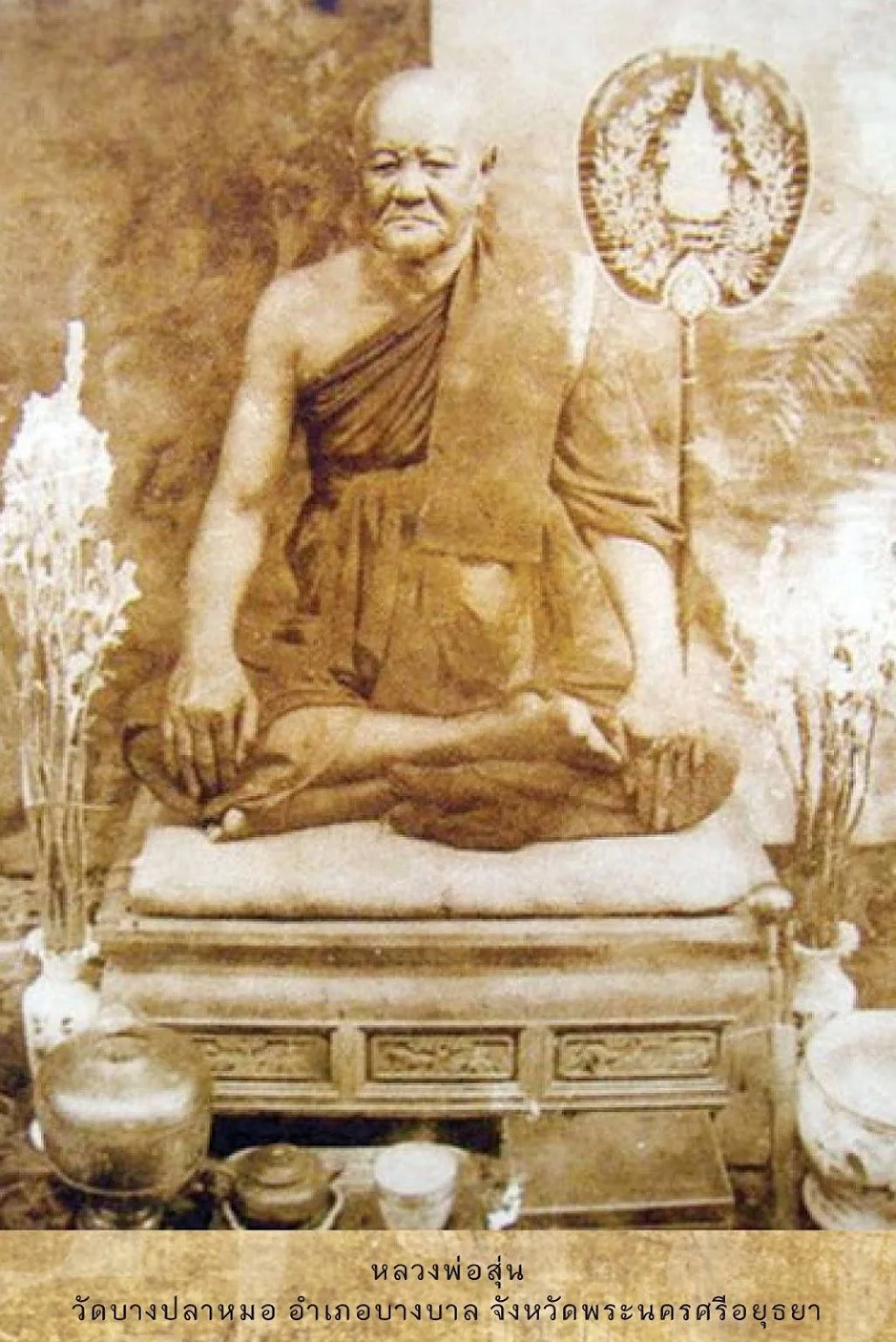
“On the 5th day, at about one in the morning, the water had receded enough for the bridge to be crossed. I went up to take photographs in the pavilion that I mentioned yesterday. There is a statue of Phra Palelai and a statue of the abbot of Wat Bang Pla Mo, as written on the inscription. The statue of the abbot is life-sized and depicts a handsome figure. This abbot was known as a doctor who treated mental illness and was said to be related to Prince Pavaret.”
This royal record suggests that by BE 2449, Luang Phor Soon had already passed away and was honored with a statue at the temple.
Another photograph of Luang Phor Soon shows him holding a ceremonial fan bearing the inscription indicating that he attended the royal cremation ceremony of Her Royal Highness Princess Saovabha Nari Ratana. This suggests that Luang Phor Soon had connections with important royal events during his lifetime.
Based on available evidence, historians estimate that Luang Phor Soon passed away around BE 2447, at approximately 89–90 years of age.
Relationship with Other Renowned Monks
Luang Phor Soon was a contemporary of several respected monks of his era, including:
-
Luang Phor Pan of Wat Phikul Sokhan
-
Luang Phor Niam of Wat Noi
He was also the preceptor (Upajjhaya) of Luang Phor Pan of Wat Bang Nom Kho, one of the most famous masters of sacred animal amulets.
According to stories passed down through villagers and later recorded by Luang Phor Rueasi Lingdam, a disciple in the lineage of Luang Phor Pan, Luang Phor Soon was highly skilled in traditional spiritual sciences and healing practices. Many monks trained under him, and he was known for passing his knowledge generously to capable disciples.
Teaching Luang Phor Pan
When Luang Phor Pan ordained, he studied with Luang Phor Soon. Under his teacher, he learned Vipassana meditation as well as various forms of traditional sacred knowledge.
Luang Phor Soon also taught him the art of healing the sick. Many people visited the temple each day seeking treatment.
One well-known story describes how Luang Phor Soon asked Luang Phor Pan to sprinkle holy water over a group of sick people. As the number of visitors grew, Luang Phor Pan noticed that the water in the jar was running low and prepared to fetch more.
Luang Phor Soon stopped him and told him simply to continue.
Even after around fifty people received the holy water, the water in the jar hardly seemed to decrease. Surprised, Luang Phor Pan later asked his teacher how this was possible.
Luang Phor Soon replied calmly:
“I scooped it with my heart.”
After that, Luang Phor Soon taught him the deeper method behind the practice.
Healing and Compassion
Before treating any patient, Luang Phor Soon was said to use spiritual insight to determine whether the illness could be cured. If it was possible, he would treat the patient. Only in cases where a person’s fate had truly reached its end would he refrain from treatment.
Because of his reputation, people traveled from many places to seek his help. Despite the large number of visitors, Luang Phor Soon continued to help people every day.
Contributions to the Temple
The villagers deeply respected him and supported his work. Whenever he planned to build or repair something at the temple, the local community would come together to help.
During his time, Luang Phor Soon oversaw the construction and renovation of many structures at Wat Bang Pla Mo, including:
-
The sermon hall
-
The ordination hall (Ubosot)
-
A vihara
-
A reclining Buddha image
-
The temple stupa
Because of these efforts, Wat Bang Pla Mo became an important religious center in the region.
Final Advice to Luang Phor Pan
Before his passing, Luang Phor Soon gave important advice to his disciple Luang Phor Pan. He told him that after his death, he should continue studying with Luang Phor Niam of Wat Noi, as the two monks were close friends and shared similar knowledge.
Sacred Objects Associated with Luang Phor Soon
According to researchers and knowledgeable collectors, three types of clay amulets are traditionally attributed to Luang Phor Soon.
1. Lotus Petal Shaped Clay Amulets
These amulets were discovered in BE 2494 when the stupa in front of the temple was opened. They are shaped like lotus petals and made from fired clay.
Two main colours appear:
-
Reddish clay
-
Dark black clay with fine texture
The Buddha image sits in the diamond meditation posture. The figure usually has a round face without clearly defined eyes or mouth, a thick torso, and large knees. The amulet typically has no pedestal, and the clay appears dry and tightly compressed.
2. Serrated Lotus Petal Style
Another type has serrated edges around the lotus-petal frame. The Buddha image is similar to the first type but has slight differences in the mold shape.
3. Pointed Lotus Petal Amulets
These were discovered much later, in BE 2528, during the demolition of an old and damaged reclining Buddha statue.
Workers found small earthenware jars hidden near the pillow supporting the Buddha’s head. Inside were approximately 300 clay amulets.
Some of these amulets show traces of termite mound soil, indicating that they had been buried for a long period.
Later Commemorative Amulets
In later years, Wat Bang Pla Mo produced several commemorative amulets honoring Luang Phor Soon.
Notable editions include:
-
BE 2508 – A bell-shaped amulet made in silver and copper by Phra Khru Siri Phatthanakit, then acting abbot of Wat Khok Suea.
-
BE 2520 – A double-sided copper amulet featuring Luang Phor Soon on the front and Luang Phor Pan of Wat Bang Nom Kho on the reverse.
-
BE 2526 – A copper amulet created to raise funds for restoration of the reclining Buddha statue.
-
BE 2532 – A 5-inch seated statue of Luang Phor Soon, produced together with statues of Luang Phor Chong and Luang Phor Pan.
Smaller statues in silver and copper were also produced, as well as a five-sided copper amulet.
Reputation Among Collectors
Among collectors and local devotees, the clay amulets of Luang Phor Soon are the most highly regarded. These pieces are valued not only for their age but also for their connection to an early spiritual lineage of Ayutthaya.
Local villagers believe these amulets carry strong protective qualities, especially relating to safety and protection from danger. Because Luang Phor Soon is known mainly within the local region, his amulets remain relatively unknown outside specialist circles.
For collectors who encounter an authentic piece, it is considered a meaningful relic connected to an important but lesser-known master in the history of Thai Buddhism.
Explore more from Thai Amulets Collection: browse all amulets, monk biographies, or discover katha sacred chants.
For broader context on Thai Buddhist traditions, see Thai amulets on Wikipedia.