Legend of Phra Kaew Morakot: The Emerald Buddha of Wat Phra Kaew
Discover the Legend of Phra Kaew Morakot: The Emerald Buddha of Wat Phra Kaew — Thailand's most sacred palladium, its history, spiritual power, and collector significance.
Legend of Phra Kaew Morakot: The Emerald Buddha of Wat Phra Kaew — History and Significance
The Legend of Phra Kaew Morakot: The Emerald Buddha of Wat Phra Kaew stands as one of the most revered stories in all of Southeast Asian Buddhism, captivating collectors in Singapore, Malaysia, Thailand, and Greater China for generations. Enshrined at Wat Phra Si Rattana Satsadaram — commonly known as the Temple of the Emerald Buddha — within the Grand Palace complex in Bangkok, this sacred image is regarded as the ultimate national palladium of Thailand. Its legend bridges centuries of history, royal devotion, and unbroken Thai Buddhist tradition.
Thailand’s Emerald Buddha is not merely a religious icon; it is a living symbol of the Thai nation’s spiritual identity and sovereignty. Kings, generals, and pilgrims have venerated this image across kingdoms and dynasties, believing its presence guarantees the prosperity and protection of the realm. For collectors and devotees of Thai amulet history, understanding the story of Phra Kaew Morakot provides essential context for the deeper spiritual currents that flow through all authentic Thai sacred objects.
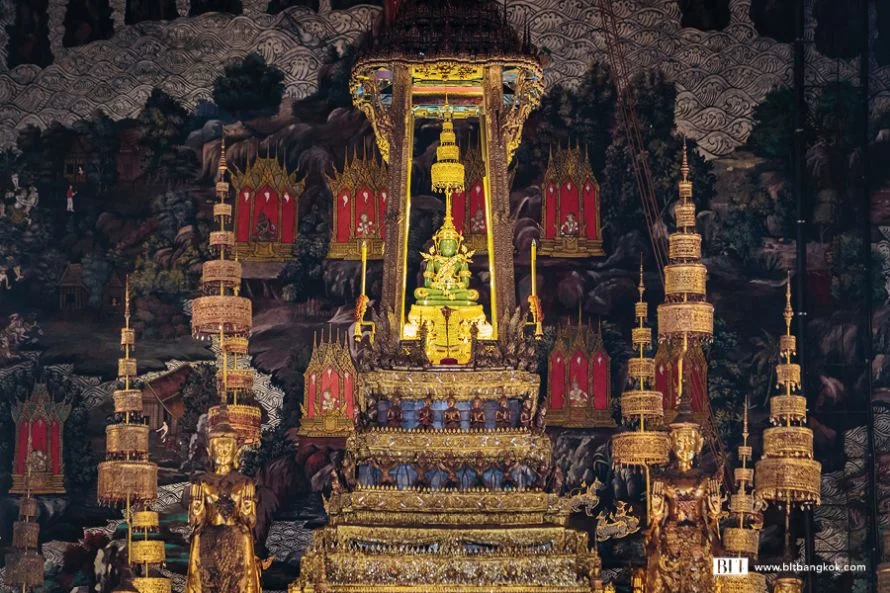
The image itself is carved from a single block of green jasper — not emerald as its name suggests — and stands approximately 66 centimetres tall in the meditation posture. Despite its relatively modest size, the Emerald Buddha commands extraordinary reverence, seated high upon a towering golden throne within its royal chapel. The Thai king himself performs seasonal robe-changing ceremonies for the image three times a year, marking the transitions between summer, rainy season, and winter.
Origins and Historical Context of Legend of Phra Kaew Morakot: The Emerald Buddha of Wat Phra Kaew
The origins of the Legend of Phra Kaew Morakot: The Emerald Buddha of Wat Phra Kaew are rooted in the ancient chronicles of Northern Thailand. According to traditional accounts, the image was first discovered in 1434 CE in Chiang Rai, when lightning struck a chedi at Wat Pa Yia, revealing a plaster-covered Buddha image beneath. When the plaster chipped away, the brilliant green stone beneath was revealed, and the image was immediately recognised as a sacred treasure of extraordinary power.
The Emerald Buddha’s journey across the kingdoms of mainland Southeast Asia is itself a remarkable chapter in Thai amulet history. After its discovery in Chiang Rai, the image was kept at various northern temples before being moved to Lampang, then to Chiang Mai, where it remained for 89 years. In 1552 CE, the Lao king Setthathirath brought the image to Luang Prabang and later to Vientiane, where it remained for over two centuries as a palladium of the Lao kingdoms.
The image was finally recaptured for Siam in 1779 CE by General Chao Phraya Chakri — who would later become King Rama I, founder of the Chakri dynasty — during his campaign in Vientiane. Upon establishing Bangkok as the new capital in 1782 CE, King Rama I enshrined the Emerald Buddha at Wat Phra Si Rattana Satsadaram, the royal temple he constructed specifically to house this most sacred of images. This act cemented the image’s role as the spiritual foundation of the Rattanakosin Kingdom.
Key Events and Sacred Significance of the Emerald Buddha Through the Ages
The Legend of Phra Kaew Morakot: The Emerald Buddha of Wat Phra Kaew is inseparable from the royal ceremonies that have surrounded it since 1784 CE, when the image was formally installed at Wat Phra Kaew. King Rama I commissioned the first set of golden seasonal robes for the image — one for the hot season and one for the rainy season — establishing a royal tradition of changing the Buddha’s vestments three times annually. King Rama III later added a third robe set for the cool season, completing the ceremonial cycle observed to this day.
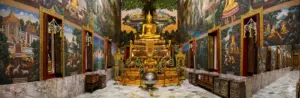
The chapel of the Emerald Buddha, known as the Ubosot, was constructed as the holiest building within the Grand Palace compound. Its walls are adorned with murals depicting the Ramakien — the Thai version of the Hindu epic Ramayana — and the entire complex is regarded as off-limits to all but the most sacred royal and religious functions. The Thai Buddhist tradition holds that the Emerald Buddha’s presence within Bangkok guarantees the stability and fortune of the Thai nation.
Throughout the Rattanakosin era, successive kings have reaffirmed their devotion to Phra Kaew Morakot through lavish restoration projects and ceremonial observances. The image survived the turbulence of wars, political upheaval, and modernisation, remaining the unchanged spiritual centre of the Thai kingdom. Its continuity across centuries makes it one of the most enduring sacred objects in all of Southeast Asian religious heritage.
Impact on Thai Amulet Tradition and Collector Value
The Legend of Phra Kaew Morakot: The Emerald Buddha of Wat Phra Kaew has profoundly shaped Thai amulet history and the broader culture of sacred image veneration across the region. The Emerald Buddha established a royal precedent for the creation, enshrining, and protection of sacred images that directly influenced how Thai Buddhist temples commission and consecrate amulets to this day. Collectors who understand this heritage recognise that every authentic Thai amulet carries a thread of this ancient tradition.
Replica images of the Emerald Buddha — known as Phra Kaew Morakot jำลอง — have been produced in limited quantities under royal patronage for distribution to important temples across Thailand and abroad. These replicas are considered among the most auspicious and collectible items in the world of Thai Buddhist sacred art. For collectors in Singapore, Malaysia, Hong Kong, and Taiwan, acquiring items connected to this lineage represents both spiritual merit and a tangible link to one of Asia’s most powerful sacred traditions.
The global scholarly community and institutions such as the Wikipedia entry on the Emerald Buddha document the image’s journey and significance, providing collectors with well-verified historical context. Understanding the provenance and royal connections of sacred objects is fundamental to responsible collecting, and the Emerald Buddha’s story provides the definitive framework for appreciating Thai Buddhist sacred art at the highest level.
Legend of Phra Kaew Morakot: The Emerald Buddha of Wat Phra Kaew — Collector Guide for Singapore and Southeast Asia
For collectors seeking authentic Thai amulet pieces inspired by or connected to the Emerald Buddha tradition, provenance and certification are paramount. The Legend of Phra Kaew Morakot: The Emerald Buddha of Wat Phra Kaew reminds us that the most sacred Thai objects are those with clear lineages, royal or temple endorsements, and documented consecration ceremonies. At Thai Amulets Collection Singapore, we advise collectors across Singapore and Southeast Asia to prioritise pieces with verifiable histories and expert authentication.
The influence of the Emerald Buddha on Thai Buddhist tradition means that even amulets not directly depicting Phra Kaew Morakot may carry its spiritual energy when consecrated at temples within the Rattanakosin lineage. As a Thai amulet Singapore resource, we encourage collectors to deepen their knowledge of Thai amulet history in order to make informed, meaningful acquisitions. Understanding the legend at the heart of Thai sacred culture is the first step toward building a collection of genuine spiritual and historical value.
Frequently asked questions
Legend of Phra Kaew Morakot: The Emerald Buddha of Wat Phra Kaew is an important chapter in Thai Buddhist amulet tradition. This article explores its historical context, key figures, and lasting influence on the collector community.
Understanding the history behind Thai amulets deepens appreciation for their spiritual and cultural value. This knowledge helps collectors make more informed decisions.
Thai Amulets Collection offers an extensive knowledge base including monk biographies, temple guides, and historical articles. Visit our Learn section for more.